

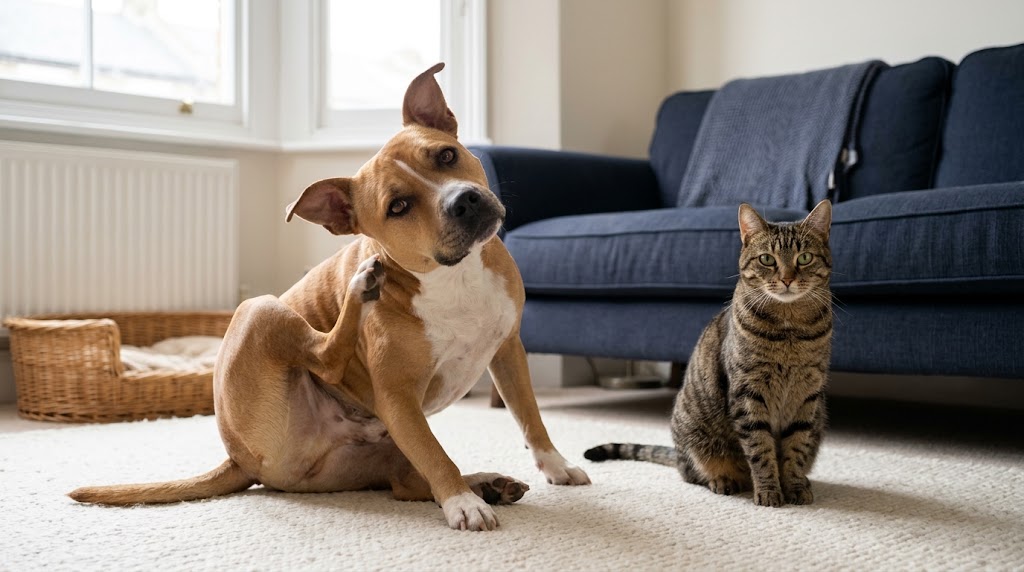
Your rescue cat has settled in beautifully, until she starts scratching at her neck and nibbling the base of her tail. Or your dog comes back from a week in kennels and cannot stop chewing his back legs. Within days, you notice itchy red spots on your own ankles too. The culprit behind all of it is usually the same: flea bites.
Flea bites are one of the most common reasons UK pets end up itchy and uncomfortable, and rescue animals often arrive with a few fleas in tow. This guide shows you what flea bites look like on cats and dogs, how vets treat itchy and allergic pets, how to stop the bites for good, and what to do when your pet’s fleas start biting you.

Key Takeaways
- You rarely see single flea bites on a cat or dog, because fur hides them; instead you see scratching, nibbling, fur loss, scabs and black flea dirt.
- On cats, flea bites often cause a small bumpy rash that feels like grit under the fur, mostly around the head, neck, lower back, tummy and back legs.
- On dogs, flea bite itching usually concentrates from the middle of the back to the base of the tail and down the back legs.
- Some pets are allergic to flea saliva, and in allergic animals a single bite can cause days of intense itching, so they need strict, year-round flea control.
- Treating flea bites on pets means treating the fleas: a vet-recommended product for every cat, dog and rabbit in the home on the same day, plus the house itself.
- Never use a dog flea treatment or a household flea spray on a cat, because many contain permethrin, which is extremely poisonous to cats.
- Fleas from pets can bite people too, usually around the ankles, and those bites stop once the pets and home are treated.
Quick Answer
Flea bites on cats and dogs show up as itching, scabs, small red bumps and fur loss rather than obvious bite marks, often on the lower back and near the tail. Confirm fleas with a flea comb and the wet paper test, then treat every pet with a vet-recommended product, treat your home, and see your vet if the skin is sore or your pet seems allergic.
What Do Flea Bites Look Like on Pets?
Flea bites on pets look like tiny red bumps or a gritty rash, but fur usually hides them. What you notice instead is the reaction: scratching, licking, nibbling, scabs, thinning fur and specks of black flea dirt. Cats and dogs react in slightly different places, which helps you spot the problem early.
| Sign | Cats | Dogs |
|---|---|---|
| Where bites and itching show | Head, neck, lower back, tummy and back legs | Middle of the back to the tail base, and down the back legs |
| What the skin looks like | Small bumpy rash that feels like grit under the fur | Small red bumps, a rash, scabs or sore patches |
| Typical behaviour | Over-grooming, licking, nibbling the back end | Scratching, chewing the back legs, turning to nibble the tail |
| Fur changes | Bald patches, rough or spiky fur | Bald patches, rough or patchy fur |
| Flea dirt | Often on the lower back | Often on the lower back and above the tail |
| Live fleas | Often groomed away, so may not be seen | Easier to spot on short or pale coats |
What Do Flea Bites Look Like on Cats?
Flea bites on cats are rarely visible as single marks, because cats groom fleas away and fur hides the skin. Look instead for over-grooming, scratching, fur loss, scabs and black flea dirt, often on the lower back. Cats that react to flea saliva develop a small bumpy rash that feels like grit when you stroke them.
According to PDSA vets, signs of fleas on cats include scratching, bald patches or rough, spiky fur, sore or infected skin, bites or a rash, nibbling the back end and flea dirt. They also note that not every cat with fleas shows symptoms, and live fleas are hard to see. A cat that seems fine can still be carrying fleas into your home.
Flea allergy dermatitis in cats
Flea allergy dermatitis is an allergy to flea saliva, and it is one of the main reasons cats react badly to flea bites. The PDSA explains that allergic cats get intense itching and a small bumpy rash every time they are bitten, typically around the head, neck, lower back, tummy and back legs.
Allergic cats often over-groom so much that you never see a flea, which can make owners doubt the diagnosis. Constant licking can leave red, raw, infected patches. The PDSA notes that flea allergy can develop at any age, but with treatment most allergic cats live a normal, happy life. Other skin conditions can look similar, so our guide to skin diseases in cats is worth a read before your vet visit.
Flea bites on cats: treatment
Treating flea bites on cats means getting rid of the fleas first, then helping the skin heal. Use a vet-recommended flea product on every cat, dog and rabbit in the home on the same day, treat the house, and worm your cat. Cats with sore, infected or allergic skin usually need a vet appointment for extra treatment.
- Choose an effective product: The PDSA recommends prescription flea treatments from your vet, or NFA-VPS products sold from locked cabinets in pharmacies, vet practices and pet shops. Off-the-shelf supermarket products often contain less effective ingredients.
- Never use dog products on cats: Dog flea treatments and household flea sprays often contain permethrin, which the PDSA warns is extremely poisonous to cats. If your cat comes into contact with one, contact your vet immediately.
- Treat the skin: During an allergic flare-up, the PDSA says your vet may prescribe steroids to calm the itch and inflammation, and antibiotics if the skin is infected.
- Stop the damage: A buster collar or body suit can protect raw skin at the start of a flare-up, but the PDSA advises using it only until medication starts working, which usually takes 12 to 48 hours.
- Worm at the same time: Fleas can pass tapeworm to cats, so the PDSA advises worming alongside flea treatment.
- Be wary of home remedies: The PDSA cautions that many non-prescription products claiming to treat flea allergy lack evidence, and some can make the skin worse.
Not sure which format suits your cat? Our guide to types of flea treatments compares spot-ons, tablets and other options.
Flea Bites on Dogs: What Do They Look Like?
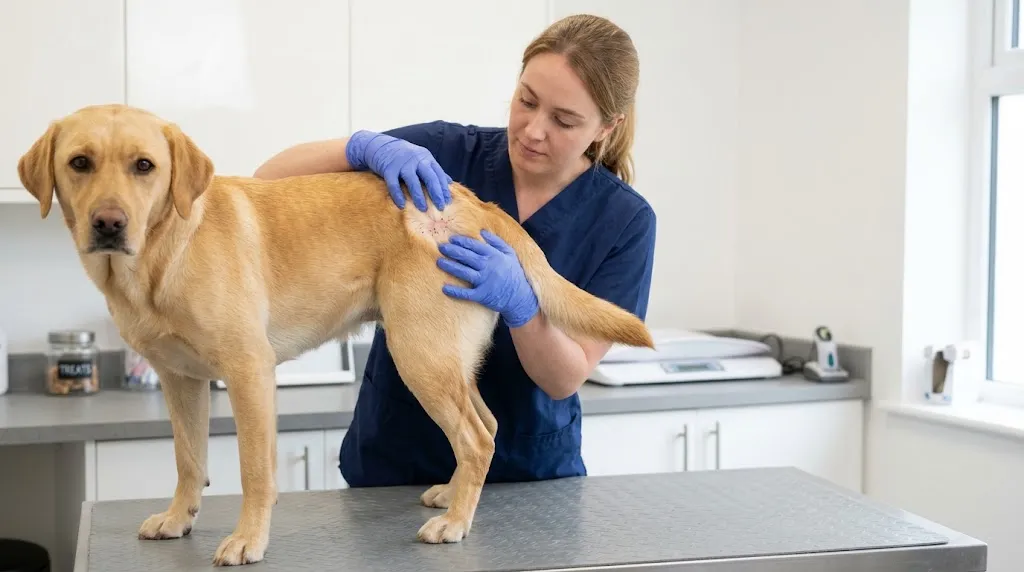
Flea bites on dogs look like small red bumps, a rash or scabs, usually hidden under the coat. The clearest signs are scratching, chewing the back legs, turning quickly to nibble the tail, flea dirt on the lower back, bald patches and sore or infected skin. Itching is often worst from the middle of the back to the tail base.
The PDSA lists scratching, flea dirt, bites or a rash, bald patches or rough fur, wounds, infected skin and turning to nibble the back end as typical signs of fleas on dogs. To check, part the fur along your dog’s spine and just above the base of the tail, where fleas and their droppings gather.
Flea allergy dermatitis in dogs
Flea allergy dermatitis in dogs is an allergic reaction to proteins in flea saliva, and it makes even a light flea problem intensely itchy. VCA Animal Hospitals (a US veterinary group) notes that in allergic dogs, a single flea bite can cause itching for several days.
VCA describes the signs as most often seen from the middle of the back to the tail base and down the rear legs, an area vets call the flea triangle. Because fleas only stay on the dog while feeding, allergic dogs can be miserable even when you cannot find a single flea. Dogs with other allergies, such as pollen or dust mite allergies, tend to be more sensitive. Our guide to allergies in dogs explains how flea allergy fits alongside food and seasonal allergies.
Treatment
Treating flea bites on dogs follows the same rule as cats: stop the fleas, then treat the skin. Use a vet-recommended flea product on every pet in the house, treat your home, worm your dog, and book a vet visit for sore, infected or allergic skin.
- Licensed flea control: The PDSA advises prescription products from your vet where possible, or NFA-VPS products if not. Your vet will need your dog’s weight to dose correctly.
- Keep cats safe: The PDSA warns that some dog flea treatments are highly toxic to cats. Keep cats away from a freshly treated dog and follow the label exactly.
- Calm the itch: For allergic flare-ups, VCA notes that vets often use corticosteroids short term, plus antibiotics if scratching has caused a skin infection. Strict flea control continues even when no fleas are seen.
- Worm your dog: Fleas pass tapeworm to dogs, so the PDSA recommends regular worming, especially after fleas. Our guide to worms in dogs and cats explains why.
- Consider a collar carefully: Some dogs do well on a licensed flea collar, but many supermarket collars no longer hold a UK licence. Our flea and tick collar guide shows which ones are worth buying.
For a deeper dive into dog fleas, read My Dog Has Fleas? 14 Questions Answered.
How to Check Your Pet for Fleas: The Flea Dirt Test
The flea dirt test is the quickest way to confirm that itching is caused by flea bites. Flea dirt is flea droppings made of digested blood, so it turns reddish-brown when wet. Ordinary dirt stays grey or black. A positive test means fleas, even if you never see one.
- Stand your pet on a white towel or sheet of paper.
- Comb the fur along the back and above the tail with a fine-toothed metal flea comb.
- Tap any black specks onto a damp white paper towel.
- Wait a few seconds. Reddish-brown smudges or rings around the specks mean flea dirt.
- Check every pet in the house, not just the one scratching.
Are Flea Bites Dangerous for Cats and Dogs?
Flea bites are usually more uncomfortable than dangerous for healthy adult pets, but they can cause real harm in some situations. Heavy infestations can cause anaemia, scratching can lead to skin infections, allergic pets can suffer badly, and fleas pass on tapeworm. Kittens, puppies, elderly and ill pets are most at risk.
- Anaemia: The PDSA warns that large numbers of fleas feeding on a pet can cause dangerous blood loss, especially in young, old or ill animals. Pale gums, weakness and tiredness in a flea-ridden kitten or puppy need an urgent vet visit.
- Skin infections: Constant scratching and licking break the skin, letting bacteria in. Dogs can develop painful hot spots.
- Flea allergy: Allergic pets can scratch themselves raw from just a few bites.
- Tapeworm: Pets swallow infected fleas while grooming and pick up tapeworm.
How Long Do Flea Bites Last on Pets?
Flea bites on pets keep itching for as long as fleas keep biting, so the itch rarely settles until the infestation is treated. In allergic dogs, VCA notes that one bite can cause itching for several days. Once fleas are under control and any vet treatment starts, most pets become noticeably more comfortable within days, while damaged skin and fur take longer to recover.
If your pet is still itchy a couple of weeks after thorough flea treatment, speak to your vet. The cause may be a skin infection, an allergy to something else, or fleas still hatching in the home.
How to Relieve Itchy Flea Bites on Your Pet
The fastest way to relieve itchy flea bites on your pet is to kill the fleas with a vet-recommended product and let your vet treat any sore or allergic skin. While you wait for an appointment, keep your pet comfortable and stop them damaging their skin further.
- Start an effective flea treatment straight away, on every pet in the house.
- Wash your pet’s bedding at 60°C so they are not lying in flea eggs and dirt.
- Keep nails trimmed to reduce scratch damage.
- Ask your vet about a buster collar or body suit if your pet is licking or chewing sores.
- Do not give your pet human antihistamines, creams or painkillers unless your vet tells you to. Some human medicines are dangerous to cats and dogs.
- Skip flea shampoos as a fix: the PDSA says they are not very good at killing fleas.
When to See a Vet About Flea Bites
See your vet if your pet has sore, broken or infected skin, is losing fur, seems allergic, or is still itchy after correct flea treatment. Young, old or unwell pets with fleas should be checked promptly. If your pet has been in contact with the wrong flea product, call your vet immediately.
| Situation | What to do |
|---|---|
| Mild scratching, flea dirt found, pet otherwise well | Call your vet practice for a suitable flea product |
| Red, raw, scabby or weeping skin, or bald patches | Book a vet appointment |
| Intense itching from only a few fleas, or no fleas found | Book a vet appointment to check for flea allergy |
| Kitten, puppy, elderly or ill pet with lots of fleas, pale gums or weakness | See a vet urgently |
| Cat exposed to a dog flea treatment or household flea spray | Contact your vet immediately |
| Still itchy weeks after correct flea treatment | Ask your vet about other causes |
How to Stop Flea Bites for Good: Treat Pets and Home Together
The only lasting way to stop flea bites is to treat every pet and your home together. The PDSA estimates that 95% of a flea problem lives in the home, and that 50 fleas on a pet can mean up to 1,000 fleas and eggs in carpets and furnishings, able to survive for up to a year.
- Treat every pet on the same day: All cats, dogs and rabbits, as the PDSA advises, even those that are not scratching.
- Vacuum daily: Focus on carpets, rugs, sofas, skirting boards and pet beds, and empty the cylinder or bag into an outside bin straight away, as Watford Borough Council suggests.
- Hot wash bedding: Wash pet bedding and throws at 60°C, following PDSA guidance.
- Use a household flea spray safely: Many contain permethrin, which is toxic to cats, fish and birds. Keep pets out of treated rooms until dry, cover fish tanks, and follow the label.
- Worm your pets: Do this alongside flea treatment to break the tapeworm cycle.
- Expect a second wave: Eggs and cocoons keep hatching. Watford Borough Council notes that fleas reappearing 7 to 10 days after treatment is normal while the product keeps working.
- Keep it up: Treat pets as often as your vet recommends, and the PDSA suggests treating your home once a year to prevent a comeback.
Why fleas bite after a holiday, kennels or a house move
Fleas often bite hardest when you come back to an empty house or move into a new one. Young fleas wait in cocoons in carpets and floorboards, then hatch when they sense vibration and warmth. Watford Borough Council explains this is why people get bitten in properties left empty for a while. When your pet comes home from kennels or a cattery, that waiting flea population is ready to jump straight back on.
Flea control methods to avoid
Some popular home tricks are unsafe or simply do not work. Do not cut up flea collars and scatter the pieces around the house: collars are dosed for wearing on one animal, and loose pieces can be chewed by pets or picked up by children. Avoid candle-and-water flea traps, which are a fire risk and do nothing about eggs and cocoons. Never use garlic or onion as a flea remedy, as both are toxic to cats and dogs.
Can Your Pet’s Fleas Bite You?
Yes, cat and dog fleas bite people, but they cannot live on us. The PDSA notes that if your pet has fleas, you may notice itchy bite marks around your ankles or on your arms. Bites on you are a strong sign that your home has fleas, even if your pet seems fine.
What do flea bites look like on people?
Flea bites on people look like small, swollen, very itchy spots with a single puncture point in the centre, often in clusters or lines of two. North West Leicestershire District Council notes there can be a delay of several hours before a bite reacts. The NHS says flea bites are usually found in groups below the knees, and may be harder to see on brown or black skin.
Most bites settle within a few days, though UK sources vary. Fareham Borough Council says a bite usually irritates for one to two days, while North West Leicestershire District Council says bites can stay itchy for up to several weeks. Fareham also notes that in the UK fleas are not generally responsible for spreading infection to people.
How to relieve flea bites on yourself
You can usually treat your own flea bites at home, following NHS advice for insect bites. Wash them with soap and water, hold a cold compress on swollen bites for at least 20 minutes, and try not to scratch. A pharmacist can recommend antihistamines for itching or hydrocortisone cream for itching and swelling.
Ask a pharmacist before using these on children or during pregnancy; the NHS advises children under 10 and pregnant women to get a doctor’s advice before using hydrocortisone cream. See a pharmacist if a bite looks infected, contact NHS 111 or your GP if symptoms worsen, and call 999 for swelling of the lips, mouth or throat, or difficulty breathing.
Flea bites vs bed bug bites
Flea bites and bed bug bites can look alike, but where they appear and whether your pets are scratching usually settles it. Flea bites cluster around the ankles and lower legs. The NHS says bed bug bites tend to appear on skin exposed while sleeping, such as the face, neck and arms, often in a line.
| Clue | Flea bites | Bed bug bites |
|---|---|---|
| Where on your body | Mostly ankles, feet and lower legs | Face, neck and arms |
| Pets scratching? | Usually yes | Not linked to pets |
| Signs in the home | Flea dirt in pet fur and bedding, tiny jumping insects | Blood spots and small brown marks on sheets or mattress |
| Who to call | Your vet for the pets; council or pest control for the home if needed | Local council or pest control service |
FAQs
What do flea bites look like on cats?
Flea bites on cats are rarely visible as single marks because fur hides them and cats groom fleas away. Look for over-grooming, scratching, fur loss, scabs and black flea dirt on the lower back. Allergic cats develop a small bumpy rash that feels like grit under the fur, often around the head, neck and back.
What do flea bites look like on dogs?
Flea bites on dogs look like small red bumps, a rash or scabs, usually hidden under the coat. The clearest signs are scratching, chewing the back legs, nibbling at the tail, bald patches and flea dirt. Itching is often worst from the middle of the back to the base of the tail.
How do vets treat flea bites on cats?
Vets treat flea bites on cats by clearing the fleas with an effective licensed product for every pet in the home, advising on treating the house, and worming the cat. For allergic or sore skin, a vet may prescribe steroids to calm itching and inflammation, and antibiotics if the skin is infected.
Can one flea bite make my pet itchy?
Yes, if your pet is allergic to flea saliva. In allergic dogs, a single flea bite can cause itching for several days, and allergic cats react with intense itching and a bumpy rash every time they are bitten. These pets need strict, regular flea control even when no fleas are seen.
Can I put human anti-itch cream on my dog or cat?
No, not without your vet’s advice. Some human medicines and creams are harmful to pets, and cats and dogs often lick creams off, swallowing them. Your vet can prescribe safe treatment for itchy, allergic or infected skin, and the most important step is killing the fleas causing the bites.
Why is my indoor cat getting flea bites?
Indoor cats can still get fleas, because fleas and their eggs are carried in on shoes, clothes, other pets and visitors’ animals, or left behind by a previous occupant’s pets. Once inside, fleas breed in carpets and bedding, so indoor cats need regular flea treatment too.
Can my pet’s fleas bite me?
Yes, cat and dog fleas can bite people, usually around the ankles and lower legs, but they cannot live on humans. Bites on you are a sign your home has fleas. They stop once every pet and the home are treated, and a pharmacist can help with itchy bites in the meantime.
Are flea bites dangerous for kittens and puppies?
Yes, they can be. Large numbers of fleas can cause dangerous blood loss, called anaemia, in kittens, puppies and elderly or ill pets. Signs include pale gums, weakness and tiredness. A young pet with lots of fleas should see a vet promptly for safe, age-appropriate treatment.
Related Articles
- My Dog Has Fleas? Dog Fleas: 14 Questions Answered
- Types of Flea Treatments: Which Works Best?
- Top 10 Flea and Tick Collars for Dogs: 5 to Buy, 5 to Skip
- 12 Skin Diseases in Cats
- How Common is Allergy in Dogs?
Conclusion
Flea bites on cats and dogs rarely look dramatic, but they cause real discomfort, and for allergic pets, kittens and puppies they can become a genuine health problem. Watch for scratching, over-grooming, scabs and flea dirt, confirm with a flea comb and a damp paper towel, and get your vet involved when skin is sore or itching seems out of proportion.
The bites only stop when the fleas do. Treat every pet on the same day, treat your home, worm your pets, and keep up regular prevention with your vet’s advice. It takes a few weeks, but your pets, and your ankles, will thank you.
Rescue pets often arrive with a few unwanted passengers, and a flea plan is one of the kindest first steps you can take together. If you are ready to give a dog a second chance, start with our guide to adopting a dog in the UK and help a rescue dog settle into an itch-free new home.
Medical Disclaimer: This article is for general information and does not replace professional veterinary or medical advice. Always speak to your vet about your pet’s skin, fleas or treatment. For bites on people, speak to a pharmacist, GP or NHS 111, and call 999 in an emergency.