

Fish antibiotics are medicines that kill or stop the growth of harmful bacteria in fish. They can save a sick goldfish, betta or koi, but only when the problem really is bacterial and the right drug is chosen.
Many fishkeepers, including those who take on rescued or rehomed tanks, search for fish antibiotics the moment a fish looks unwell. The problem is that much of the advice online is written for the US market, where some antibiotics are sold over the counter. In the UK, the rules are very different.
This guide explains what fish antibiotics are, when they help, which conditions they treat (and which they do not), how UK law applies, and why these medicines are never safe for people, cats or dogs.
Quick Answer
| Question | Short Answer |
|---|---|
| What are fish antibiotics? | Medicines that treat bacterial infections in fish, given through the water, in food or by injection. |
| Can you buy them in the UK? | Not legally without a prescription, because UK law requires a vet to prescribe antibiotics after examining the fish. |
| What is the best fish antibiotic? | There is no single best one; a vet picks the drug based on the bacteria found, ideally after a sensitivity test. |
| Are they safe for humans or cats? | No. They are not made, tested or dosed for people or other pets and can cause harm. |
Key Takeaways
- Fish antibiotics only work against bacteria, so they will not cure fungal, parasitic or viral disease, or problems caused by poor water quality.
- In the UK, antibiotics for fish are prescription-only veterinary medicines, and obtaining them without a prescription is a criminal offence.
- Most disease-causing bacteria in fish are gram-negative, so a drug such as amoxicillin is often a poor match for common fish infections.
- Dropsy and swim bladder problems are symptoms with several possible causes, so antibiotics help only when a bacterial infection is behind them.
- Koi with deep ulcers are usually treated by a vet with antibiotic injections, often after a swab or blood culture to identify the bacteria.
- Fish antibiotics are not safe for humans, cats or dogs because their contents, quality and dose are not controlled for those species.
- Clean water, quarantine for new fish and completing any prescribed course are the best ways to prevent infections and antibiotic resistance.
What Are Fish Antibiotics?
Fish antibiotics are antibacterial medicines used to treat infections in ornamental fish such as goldfish, bettas, tetras and koi. They work in one of two ways: they either kill bacteria directly or stop them from multiplying so the fish’s immune system can clear the infection.
The important point is that antibiotics target bacteria only. According to the Ornamental Aquatic Trade Association (OATA), specific antibiotics treat specific bacterial infections and will not treat viral, fungal, protozoan or parasitic disease. White spot, for example, is a parasite, so an antibiotic will not help.
What Is Not an Antibiotic
Several popular aquarium remedies are often called antibiotics when they are not. Methylene blue, aquarium salt and the general antibacterial or antifungal water treatments sold in UK fish shops are not antibiotics. These products can be sold without a prescription under the UK exemption scheme for small pet animal medicines, which covers fish kept in closed water systems but excludes substances that need veterinary control.
Can You Buy Fish Antibiotics in the UK?
No, not without a prescription. In the UK, antibiotics are classed as POM-V medicines, meaning only a veterinary surgeon can prescribe them. OATA’s guidance sets out the key rules:
- Vet prescription only: Only a veterinary surgeon can prescribe antibiotics for fish, corals or other aquatic animals.
- Examination first: The vet must carry out a clinical assessment, including a physical assessment, before prescribing.
- No routine or preventive use: Antibiotics cannot be prescribed to make up for poor husbandry or to prevent disease, except in rare, documented situations.
- Buying online is illegal: Obtaining antibiotics without a prescription, including from overseas websites, is a criminal offence in the UK.
Practical Fishkeeping has reported that antibiotic fish treatments found in some UK shops were being sold illegally, with the Veterinary Medicines Directorate confirming that antibiotics need veterinary control. If a shop or website offers antibiotics with no prescription, treat that as a warning sign rather than a bargain.
Why the US Is Different
Products such as “Fish Mox” (amoxicillin) and “Fish Flex” (cephalexin) are widely discussed online because they have been sold in the US without a vet. The US Food and Drug Administration has issued warning letters to sellers of these unapproved fish antibiotics, stating that medically important antimicrobials should be used under veterinary supervision. UK owners should not follow US dosing guides or buy these products.
Signs Your Fish May Need Antibiotics
Bacterial infections usually follow stress. The Merck Veterinary Manual lists poor water quality, handling, transport, sudden temperature changes and low oxygen as common triggers. Signs that suggest a bacterial problem include:
- Red streaks, bleeding spots or red patches on the body or fins
- Open sores or ulcers, especially on koi and goldfish
- Fins that look ragged, frayed or are rotting back towards the body
- White or grey cotton-like patches on the mouth, skin or gills
- A swollen belly with scales standing out like a pine cone
- Lethargy, loss of appetite and gasping, often alongside the signs above
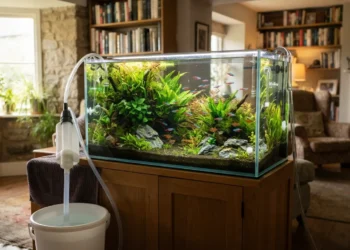
Before reaching for any medicine, test the water for ammonia, nitrite, nitrate and pH. Many fish that look “infected” are actually reacting to poor water, and fixing that is the first treatment. Our guide on how to clean a fish tank walks through safe water changes.
Common Bacterial Conditions in Pet Fish
| Condition | Usual Bacteria | Typical Signs | Do Antibiotics Help? |
|---|---|---|---|
| Fin rot | Aeromonas, Pseudomonas | Frayed, shrinking fins | Sometimes; mild cases often improve with clean water alone |
| Columnaris | Flavobacterium columnare | Cotton-like patches, "saddleback" marks | Yes, if caught early and prescribed |
| Ulcer disease | Aeromonas salmonicida | Deep red ulcers, common in koi and goldfish | Yes, usually by vet injection |
| Bacterial septicaemia | Aeromonas, Pseudomonas, Vibrio (marine) | Red streaks, bleeding, lethargy | Yes, when fish are dying and the cause is confirmed |
| Dropsy | Often Aeromonas, but not always bacterial | Swollen body, raised scales | Only in early, bacterial cases |
| Fish TB (mycobacteriosis) | Mycobacterium species | Weight loss, sores, bent spine | No; there is no effective cure |
Common Antibiotics Vets Use for Fish
The Merck Veterinary Manual notes that most bacteria that cause disease in fish are gram-negative, and it recommends sensitivity testing before any antibiotic is used. That is why your vet may take a swab, gill sample or blood culture before choosing a drug. Common examples include:
- Oxytetracycline: A broad-spectrum antibiotic often given in medicated food for internal infections.
- Erythromycin: Mainly active against gram-positive bacteria such as Streptococcus, so it suits fewer fish infections than many owners assume.
- Florfenicol: Used in medicated feed, mostly in aquaculture, for gram-negative infections.
- Enrofloxacin: A vet-only drug sometimes given by injection to valuable fish such as koi.
- Amoxicillin: Widely sold online as a fish antibiotic, but often a weak match for typical fish bacteria (see below).
Dosage, route and course length depend on the species, water temperature, tank volume and the bacteria involved. Only your vet should set these.
Fish Antibiotics: Amoxicillin
Amoxicillin is a penicillin-type antibiotic best known for treating gram-positive bacteria in people. Because most fish pathogens are gram-negative, amoxicillin is often not the right choice for fin rot, ulcers or dropsy. Using the wrong antibiotic means the infection keeps going while bacteria are exposed to the drug, which encourages resistance. The fish amoxicillin products sold online in the US are among those targeted by the FDA warning letters, and they cannot be legally bought in the UK without a prescription.
What Is the Best Fish Antibiotic?
There is no single best fish antibiotic. The right drug is the one the bacteria are sensitive to, given by the right route at the right dose. A broad-spectrum antibiotic chosen by guesswork may do nothing, kill the beneficial bacteria in your filter, or leave behind tougher bacteria that are harder to treat next time.
The most reliable path is a vet visit with a sensitivity test. For valuable fish, the Merck Veterinary Manual notes that a blood culture can identify the bacteria without harming the fish.
Freshwater Fish Antibiotics
In freshwater tanks and ponds, Aeromonas and Pseudomonas are the bacteria most often involved, along with Flavobacterium columnare in warmer water. These bacteria live in almost every aquarium and usually cause disease only when fish are stressed or water quality drops.
If your vet prescribes treatment, they may ask you to move the fish to a hospital tank. This protects the main tank’s biological filter, which antibiotics can damage, and makes dosing more accurate. A hospital tank needs a heater, an air stone and a mature or seeded filter. Read our fish tank filter guide for help choosing one, and our guide to setting up a freshwater aquarium for the basics of a stable tank.
Koi Fish Antibiotics
Koi are large, long-lived and kept in big ponds, so treating the whole pond with antibiotics is rarely practical or effective. The main bacterial threat is ulcer disease, caused by Aeromonas salmonicida. The Merck Veterinary Manual describes it as a very important disease of koi and goldfish, producing deep ulcers that can spread into the muscle.
Typical veterinary treatment for koi includes:
- Sedation and examination: The vet sedates the koi to check ulcers, gills and skin safely.
- Swab or blood culture: This identifies the bacteria and which antibiotics will work.
- Antibiotic injection: Injections deliver a measured dose directly, often repeated over several visits.
- Wound care: Ulcers are cleaned and protected to help them heal.
- Pond checks: Water quality, oxygen and stocking levels are reviewed, as stress often triggers outbreaks.
Ulcers often appear as water warms after the colder months, when bacteria become active before the koi’s immune system has fully caught up. Learn more about caring for these fish in our article on why koi make great companions.
Fish Antibiotics for Dropsy
Dropsy is not a single disease. It is a sign that fluid is building up inside the fish, usually because the kidneys or other organs are failing. The most common trigger is a bacterial infection such as Aeromonas, but dropsy can also follow parasites, tumours, liver disease or long-term exposure to poor water.
Antibiotics can help in early cases where a bacterial infection is the cause and the fish is still eating. Once the scales stand out all over the body like a pine cone, the outlook is usually poor, even with treatment. In that situation, ask your vet about humane options; our guide on how to put a sick fish to sleep humanely explains what is involved.
If more than one fish develops dropsy, the tank may have a wider bacterial problem, so contact a vet promptly and test your water straight away.
Fish Antibiotics for Swim Bladder Problems
Swim bladder disorder means a fish cannot control its buoyancy. It may float upside down, sink to the bottom or swim on its side. Fancy goldfish and bettas are especially prone.
In most cases, the cause is not bacterial. Common causes include overfeeding, constipation, gulping air with floating food, water that is too cold, and the compact body shape of fancy goldfish. These problems are managed by improving diet and water, not with antibiotics.
Antibiotics are only useful when a bacterial infection of the swim bladder or nearby organs is confirmed or strongly suspected. US pet retailer Chewy’s swim bladder guide notes that vets often use X-rays to look at the swim bladder, because it shows clearly when filled with air. If buoyancy problems last more than a few days despite better feeding and clean water, or come with red marks or swelling, see a vet.
How Antibiotics Are Given to Fish
| Method | How It Works | Best For | Drawbacks |
|---|---|---|---|
| In-water (bath) | The drug is added to a hospital tank | Skin, gill and fin infections | Can harm filter bacteria; some drugs absorb poorly |
| Medicated food | The drug is mixed into food or pellets | Internal infections in fish that are still eating | Useless if the fish has stopped feeding |
| Injection | A vet injects a measured dose | Koi and other large or valuable fish | Needs sedation and vet visits |
Whichever method your vet chooses, finish the full course even if the fish looks better, and do not reuse leftover medicine for a different fish or problem.
Are Fish Antibiotics Safe for Humans?
No. Fish antibiotics are not safe for people, even when the label names the same drug as a human medicine.
A study presented to US hospital pharmacists, reported by Pharmacy Times, found online reviews in which buyers said they had taken fish antibiotics themselves. The researchers warned of treatment failure, side effects and resistance, and noted these products are not regulated by the FDA. The Tennessee Poison Center has described a patient who needed emergency hospital care after self-treating with fish antibiotics.
The main risks are:
- Unknown contents: There is no guarantee the product contains the stated drug, strength or purity.
- Wrong drug: Without a diagnosis, many infections (including colds and flu, which are viral) will not respond to antibiotics.
- Wrong dose: Under-dosing can breed resistant bacteria; overdosing can cause side effects.
- Allergic reactions: Penicillin-type drugs can trigger serious reactions in allergic people.
In the UK, anyone who thinks they need antibiotics should speak to a GP, pharmacist or NHS 111.
Can Cats Take Fish Antibiotics?
No. Cats and dogs should never be given fish antibiotics. Cat and dog doses are worked out by bodyweight and condition, and some drugs that are fine for fish can cause serious side effects in cats. Fish products also have no quality control for use in mammals, and buying antibiotics without a prescription is illegal in the UK whatever the animal.
Vet charity PDSA warns owners not to try home treatments or medicines seen online without first checking with their vet. If your cat seems to have an infection, book a vet appointment. Many practices offer payment plans, and PDSA helps eligible owners with free or low-cost care.
How to Prevent Bacterial Infections and Antibiotic Resistance
OATA states that buying healthy fish and keeping them in a well-maintained tank of the right size, with suitable tankmates and good water quality, is the best way to prevent disease. In practice, that means:
- Test water weekly: Keep ammonia and nitrite at zero and nitrate low.
- Change water regularly: Partial water changes, with dechlorinated water at a matching temperature, keep waste in check.
- Quarantine new fish: Keep new arrivals in a separate tank for several weeks before adding them to your main tank or pond.
- Avoid overcrowding: Too many fish means more waste and more stress.
- Feed carefully: Uneaten food rots and fuels bacterial growth.
- Dispose of water safely: OATA warns that tank water can carry resistant bacteria into the environment, so avoid pouring treated water into outside drains.
A note for your own health: some fish bacteria, including Mycobacterium marinum, can infect people through cuts. Wear gloves when cleaning tanks if you have broken skin, and wash your hands afterwards.
How to Find a Fish Vet in the UK
Not every vet treats fish, so it helps to know where to look before an emergency:
- Fish Veterinary Society list: OATA’s find a fish vet page explains that the Fish Veterinary Society keeps a list of vets willing to treat fish, including pet fish.
- RCVS specialist register: The RCVS Find a Vet tool lists vets recognised as specialists in fish health.
- Your local aquatic shop: OATA member retailers can often recommend nearby vets who see fish.
- Your usual vet: Even if they do not treat fish, they may refer you or consult a fish vet.
FAQs
What are fish antibiotics?
Fish antibiotics are medicines that kill bacteria or stop them from multiplying in fish. They treat bacterial infections such as columnaris, ulcer disease and some cases of fin rot and dropsy. They do not treat parasites, fungi, viruses or problems caused by poor water quality.
Can I buy fish antibiotics without a prescription in the UK?
No. In the UK, antibiotics for fish are prescription-only veterinary medicines. A vet must examine the fish before prescribing, and obtaining antibiotics without a prescription, including online, is a criminal offence.
Are fish antibiotics the same as human antibiotics?
Some fish products name the same active ingredient as human medicines, such as amoxicillin. However, fish antibiotics are not made or checked to human medicine standards, so their contents, strength and purity cannot be trusted. They should never be taken by people.
What is the best antibiotic for fish?
There is no single best antibiotic for fish. The right choice depends on which bacteria are causing the infection, so vets often take a swab or culture and run a sensitivity test before prescribing.
Can antibiotics cure dropsy in fish?
Antibiotics can help early dropsy when a bacterial infection is the cause and the fish is still eating. Once the scales stand out all over the body, the outlook is usually poor, and a vet may advise humane euthanasia.
Do fish need antibiotics for swim bladder disorder?
Usually not. Most swim bladder problems are caused by overfeeding, constipation, cold water or body shape. Antibiotics are only useful if a vet confirms or strongly suspects a bacterial infection.
Can I give my cat fish antibiotics?
No. Fish antibiotics are not dosed or quality-checked for cats, some drugs can cause serious side effects in cats, and buying antibiotics without a prescription is illegal in the UK. Always ask your vet.
Related Articles
- How to Clean a Fish Tank: A Step-by-Step UK Guide
- Fish Tank Filter Guide: How to Choose, Use and Clean One
- Setting Up a Freshwater Aquarium
- Why Koi Fish Make a Great Companion
- Best Fish Tanks
Conclusion
Fish antibiotics are valuable medicines, but they are not a first-aid kit. They only work on bacterial infections; they only work when the right drug is matched to the right bacteria, and in the UK they are only legally available through a vet. For dropsy, swim bladder problems and most cases of fin rot, the first steps are testing the water, fixing the cause and moving the fish to a hospital tank if needed.
If you have taken on a rescued or rehomed tank, start with a full water test and a calm, stable setup before adding new fish. When something looks wrong, a fish vet can give you a clear diagnosis and the right treatment, which protects your fish and keeps these medicines working for everyone. Browse more care guides in our fish section.
Medical Disclaimer: This article is for informational purposes only and does not replace professional veterinary advice. Always consult your veterinary surgeon before starting, changing or stopping any medication for your fish or other pets.