
The Abyssinian cat breed is a short-haired, athletic cat known for its ticked coat, large ears and endless curiosity. Abyssinian cat colours range from the classic warm “usual” (ruddy) to sorrel, blue, fawn, chocolate, lilac and silver, and the breed has been shaped in Britain for well over a century.
Many people search for a “grey”, “black” or “Egyptian” Abyssinian and find confusing answers. This guide explains what the breed registries actually recognise, using the UK standard from the Governing Council of the Cat Fancy (GCCF).
You will also find the Abyssinian’s origin, its history in the UK, personality, size, lifespan, health, kitten prices and insurance costs. If you are thinking of giving an Abyssinian a home, whether from a breeder or a rescue, each section below answers one question clearly.
Key Takeaways
- The Abyssinian is a medium to large, lean shorthaired cat with a ticked coat, where each hair carries at least four bands of colour.
- The GCCF recognises 28 Abyssinian colours in the UK, while the US-based CFA accepts only four: ruddy, cinnamon (sorrel), blue and fawn.
- A solid black Abyssinian is not a recognised colour, and “grey” Abyssinians are usually blue, lilac or silver cats.
- Abyssinians weigh around 4.5 kg on average and usually live 12 to 15 years with good care.
- The breed is playful, people-focused and rarely a lap cat, so it suits active homes rather than owners who are out all day.
- UK Abyssinian kittens from registered breeders typically cost £800 to £1,500, and ask for DNA test results for PK deficiency and PRA.
- Insurance for an Abyssinian usually costs more than for an average cat, so insure early before any condition is diagnosed.
Abyssinian Cat at a Glance
The Abyssinian is a foreign-type shorthair recognised by every major cat registry. The table below summarises the key facts UK owners ask about most, with each figure explained in its own section further down.
| Trait | Abyssinian cat facts |
|---|---|
| Origin | Named after Abyssinia (Ethiopia); DNA points to the Indian Ocean coast and Southeast Asia; developed in the UK |
| Breed group | Foreign shorthair (GCCF Section 4) |
| Size | Medium to large, around 20 to 25 cm tall at the shoulder |
| Weight | Average 4.5 kg; females about 3.5 to 4.5 kg, males about 4.5 to 5.5 kg |
| Lifespan | Usually 12 to 15 years |
| Coat | Short, fine, close-lying and ticked |
| Colours | Usual (ruddy), sorrel, blue, fawn, chocolate, lilac, plus silver and tortie versions (28 in total with the GCCF) |
| Eye colour | Amber, green or hazel |
| Temperament | Playful, curious, intelligent, affectionate, quietly vocal |
| Energy level | High |
| Grooming | Low: a weekly brush |
| Good with children and pets | Usually yes, with time to adjust |
| UK kitten price | Around £800 to £1,500 from registered breeders |
| Insurance | Higher than the average cat; compare lifetime policies |
| UK registry | GCCF, recognised in 1929 |
Where Does the Abyssinian Cat Come From?
Abyssinian cats are named after Abyssinia, the old name for Ethiopia, because the first famous example arrived in England from there. Genetic research tells a different story: the GCCF states that DNA analysis places the breed’s origins near the coast of the Indian Ocean, and the modern breed was developed in the UK.
The Egyptian legend
The Abyssinian’s slim body, large ears and almond eyes look strikingly like the cats in ancient Egyptian art. This resemblance led to a popular belief that Abyssinians descend from the sacred cats of the pharaohs. It is a lovely story, but there is no genetic evidence that links the modern breed directly to ancient Egypt.
What genetics and museums tell us
The evidence points east rather than to Egypt. A genetic study from UC Davis found that Abyssinians carry markers common to both Southeast Asian and Western breeds, suggesting cats from Asia and Europe were used to create the breed. The earliest known labelled specimen, a mounted cat bought around 1834 to 1836 and held by the Leiden natural history museum in the Netherlands, was recorded as coming from India, according to the breed’s documented history.
A scientific first
An Abyssinian named Cinnamon became the first cat to have its entire genome published in 2007. Her DNA has since helped researchers study inherited blindness, which links directly to the eye condition discussed in the health section below.
The Abyssinian Cat in the UK
The Abyssinian is one of Britain’s oldest established cat breeds. A cat called Zula was brought to England in 1868 at the end of the British expedition to Abyssinia, and an Abyssinian was exhibited at the Crystal Palace cat show in London in 1871. British breeders then shaped the breed we know.
From Zula to official recognition
Many breeders question whether Zula was a true Abyssinian, because early drawings show smaller ears and a longer, wavier coat than the modern breed. What is certain is that British breeders worked on the breed from the 1890s onwards. The GCCF officially recognised the Abyssinian in 1929 and places it in Section 4 (Foreign), Group 1.
Near loss and recovery
The breed was almost lost in the UK after the Second World War, when numbers fell sharply and an outbreak of feline leukaemia virus hit breeding cats. Breeders rebuilt the population with cats imported from the Netherlands, Scandinavia, North America, Australia and New Zealand.
Registering and finding Abyssinians in Britain
UK Abyssinians are registered with the GCCF under strict rules. The GCCF registration policy for Abyssinians allows no outcrosses to other breeds, which protects the breed type. Dedicated breed clubs such as the Abyssinian Cat Association, a GCCF member club founded in 1975, list breeders, kittens and history. The Abyssinian is less common in UK homes than breeds like the British Longhair or Ragdoll, so expect a waiting list.
What Does an Abyssinian Cat Look Like?
An Abyssinian cat looks like a small wild cat: lean, muscular and alert, with large ears, almond-shaped amber, green or hazel eyes and a glossy ticked coat. Its long, slender legs, small oval feet and long tapering tail give it an elegant, athletic outline, which is why it photographs so well in close-up portraits.
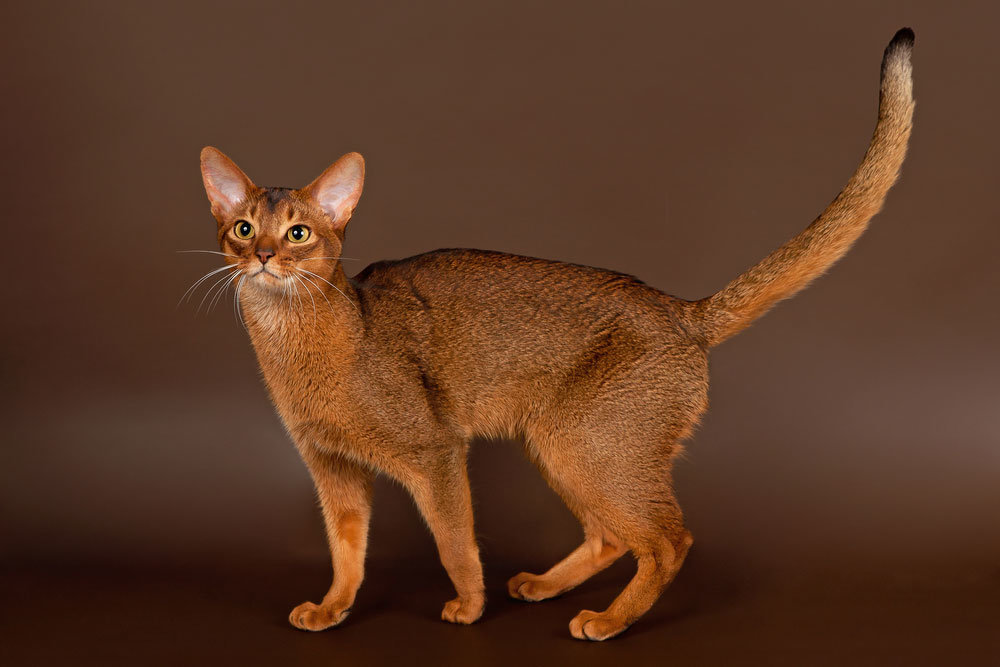
- Head: A moderate wedge with gently rounded contours, a slight nose break and a firm chin.
- Ears: Large, wide-set and cupped, often with lynx-like tufts at the tips.
- Eyes: Large, expressive and almond-shaped, outlined by darker “eyeliner” with pale fur around them.
- Body: Medium to large, lithe and muscular, with a straight back.
- Tail: Thick at the base, tapering, and ending in a solid tip of the ticking colour.
- Coat: Short, fine but not soft, dense and close-lying, with a natural shine.
These points come from the official GCCF Abyssinian Standard of Points, which judges use at UK shows.
What is a ticked coat?
A ticked coat means each individual hair is banded with alternating light and dark colours. The GCCF standard asks for at least four bands of colour, with the root matching the base colour and the tip matching the ticking colour. This gives the Abyssinian its shimmering, sand-like look instead of stripes or spots.
Abyssinian cat size
The Abyssinian is a medium to large cat, standing about 20 to 25 cm tall at the shoulder. The GCCF gives an average weight of 4.5 kg (10 lb), with females slightly smaller than males. Animal Friends lists typical weights of 3.5 to 4.5 kg for females and 4.5 to 5.5 kg for males. Despite their slim look, Abyssinians feel firm and muscular when you pick them up.
Abyssinian Cat Colours
Abyssinian cat colours depend on which registry you follow. The UK’s GCCF recognises 28 colours, including usual, sorrel, blue, chocolate, lilac, fawn, red, cream, tortie and a full silver series. The US-based Cat Fanciers’ Association (CFA) accepts only four: ruddy, cinnamon (sorrel), blue and fawn.
| Colour | Also called | What it looks like (GCCF standard) | Recognised by |
|---|---|---|---|
| Usual | Ruddy, tawny | Rich golden brown ticked with black, apricot base, brick-red nose | GCCF, CFA, TICA, FIFe |
| Sorrel | Cinnamon, red (in the US) | Lustrous copper ticked with chocolate, pink nose and pads | GCCF, CFA, TICA, FIFe |
| Blue | Often searched as “grey” | Soft warm blue ticked with deeper blue-grey on a pinkish mushroom base | GCCF, CFA, TICA, FIFe |
| Fawn | None | Warm fawn ticked with deeper fawn on a fawnish cream base | GCCF, CFA, TICA, FIFe |
| Chocolate | None | Rich copper brown ticked with dark chocolate | GCCF, TICA (not CFA) |
| Lilac | Often searched as “grey” | Warm pinkish dove-grey ticked with deeper dove-grey | GCCF, TICA (not CFA) |
| Silver series | Usual silver, blue silver and others | Silvery white base hair with coloured ticking | GCCF, TICA, FIFe (not CFA) |
| Red, cream and tortie | Tortie Abyssinian | Warm red or cream ticking, or a mix of colours in torties | GCCF |
Registry details are taken from the GCCF Standard of Points and the World Cat Congress breed comparison. Colour names vary between countries, so “usual” in the UK and “ruddy” in the US describe the same cat.
Usual (ruddy) Abyssinian
The usual Abyssinian is the original and most common colour. Its coat is a rich golden brown ticked with black, with a ruddy orange or apricot undercoat. The black tail tip and black paw pads are tell-tale signs. In the US, Australia and New Zealand this colour is called ruddy or tawny.
Sorrel Abyssinian
The sorrel Abyssinian has a bright copper coat ticked with chocolate brown. It looks redder and lighter than the usual colour, with pink paw pads and a pink nose. The CFA calls this colour cinnamon, and some US sources call it red, which can be confusing for UK buyers.
Blue Abyssinian cat
A blue Abyssinian cat is a diluted form of the usual colour. The GCCF describes it as a soft warm blue ticked with deeper blue-grey, over a pinkish mushroom undercoat. Blue Abyssinians are often described as grey, but they look warmer than a slate-grey cat because of the beige tones underneath.
Lilac Abyssinian cat
A lilac Abyssinian cat has a warm, pinkish dove-grey coat ticked with deeper dove-grey, with mauve-pink nose leather and paw pads. Lilac is the dilute form of chocolate. It is fully recognised by the GCCF and TICA but not by the CFA, so lilac Abyssinians are rarely seen outside specialist UK and European catteries.
Is there a grey Abyssinian cat?
There is no colour officially called “grey” in any Abyssinian standard. When people search for a grey Abyssinian cat, they usually mean one of three recognised colours: blue (warm blue-grey), lilac (pinkish dove-grey) or a silver Abyssinian, which has a silvery white base with darker ticking. All three are genuine pedigree Abyssinian colours.
Is there a black Abyssinian cat?
A solid black Abyssinian cat is not recognised by any registry. Genetically, the usual (ruddy) Abyssinian is already a black ticked tabby, which is why its ticking and tail tip are black. A cat that looks completely black is either another breed, a non-pedigree cat, or a usual silver Abyssinian with heavy black ticking seen in poor light.
Tabby striped Abyssinian cats
Every Abyssinian is a tabby, but a ticked tabby rather than a striped one. The ticked pattern replaces bold stripes with banded hairs. The GCCF standard allows only faint leg barring or a broken necklace marking, and it penalises unbroken necklaces, rings on the tail and substantial leg stripes. A strongly striped cat with an Abyssinian look is more likely a tabby moggy or a cross.
What is the rarest Abyssinian colour?
No registry publishes colour counts, so there is no official answer. Fawn is often described as the rarest of the four classic colours. In the UK, lilac, fawn silver, lilac silver and tortie Abyssinians are seen far less often than usual or sorrel cats, because few breeders work with these colour lines.
Abyssinian vs Somali
The Somali is the long-haired version of the Abyssinian and shares its colours and ticked pattern. The GCCF does not allow Abyssinian and Somali crosses on the Abyssinian register, so a fluffy kitten from an Abyssinian litter is registered differently.
Is There an Egyptian Abyssinian Cat?
There is no breed called the Egyptian Abyssinian. The phrase usually mixes up two separate breeds: the Abyssinian, which has a ticked coat, and the Egyptian Mau, which has natural spots. Both have a lean, athletic shape and both are linked to ancient Egyptian art, which explains the confusion.
| Feature | Abyssinian | Egyptian Mau |
|---|---|---|
| Coat pattern | Ticked (no spots) | Naturally spotted |
| Main colours | Usual, sorrel, blue, fawn and more | Silver, bronze and smoke |
| Eye colour | Amber, green or hazel | Gooseberry green |
| Origin evidence | Indian Ocean coast and Southeast Asia; developed in the UK | Linked to Egypt; developed in the US |
The Egyptian Mau details come from VCA Animal Hospitals. For a wider look at cats linked to Egypt, see our guide to the Egyptian cat breed.
Abyssinian Cat Personality and Temperament
The Abyssinian cat personality is playful, curious, intelligent and strongly people-focused. Abyssinians want to be involved in everything you do, follow you from room to room and prefer games to lap time. The GCCF describes them as vocally quiet, greeting their owners with a soft “chirrup” rather than a loud meow.
Abyssinian cat temperament in daily life
- Curious: Abyssinians investigate cupboards, shelves and bags, and they like high places to watch from.
- Intelligent: They learn games quickly, and many can be taught to fetch, according to the GCCF.
- Sociable: They usually get on with children, other cats and cat-friendly dogs after a gradual introduction.
- Strong-willed: If an Abyssinian does not want to do something, it simply will not.
- Quiet: They “talk” with soft trills and chirps rather than loud demands.
Abyssinian cat playing: how much activity do they need?
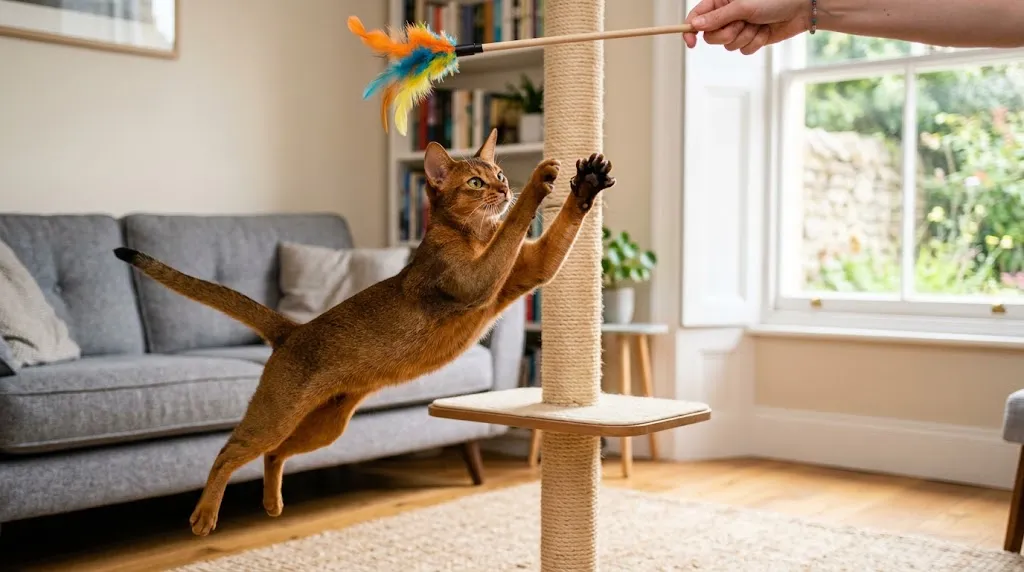
Abyssinians need daily active play, ideally two or more short sessions with wand toys, balls or puzzle feeders. They are natural climbers and jumpers, so a tall, sturdy cat tree is close to essential. Because of their energy and athleticism, they feature in our list of the most athletic cat breeds.
Are Abyssinian cats clingy?
Abyssinian cats are affectionate and people-focused, but they are more “involved” than clingy. Veterinary writer Joan Joshua described their dog-like attachment to their owners, and the GCCF notes that many follow their humans from room to room. They dislike being left alone for long periods and can become bored or mischievous without company.
Do Abyssinian cats like to be held?
Most Abyssinians do not like being held for long. They prefer to stay close on their own terms, often perching on a shoulder, sitting beside you or leaning against your legs. The GCCF says sitting on laps is mainly for when they are exhausted, and PDSA notes you are more likely to find one playing than settling on your lap.
Are Abyssinian Cats Good Pets?
Abyssinian cats make excellent pets for active households that want an interactive, affectionate companion. They suit families with children, multi-pet homes and people who work from home. They are a poor fit for owners who are out all day, want a calm lap cat, or keep small pets such as hamsters, rabbits or birds.
| An Abyssinian suits you if | An Abyssinian may not suit you if |
|---|---|
| You enjoy playing with your cat every day | You want a quiet cat that sleeps on your lap |
| Someone is at home for much of the day | The home is empty for long hours |
| You can provide climbing space and toys | You have no room for cat trees or shelves |
| You have children or other cat-friendly pets | You keep rodents, rabbits or birds |
If you are new to cats, compare the Abyssinian with our list of best cat breeds for beginners and our guide to which cat character traits suit you best.
How to Care for an Abyssinian Cat
Abyssinian care is simple for grooming but demanding for exercise and company. Their short coat needs only a weekly brush, while their busy minds need daily play, climbing space and attention. Good food, dental checks and routine vet care keep this active breed healthy.
Grooming
A soft brush once a week removes loose hair and most Abyssinians enjoy the attention. Check ears and eyes during grooming, trim claws if needed, and keep an eye on teeth, because the GCCF notes the breed can build up tartar and develop gingivitis.
Exercise and enrichment
Provide floor-to-ceiling climbing options, window perches, puzzle feeders and rotating toys. Short training sessions using treats are a great outlet for their intelligence. Without enough stimulation, Abyssinians may invent their own games on your shelves.
Indoors or outdoors?
Abyssinians can live happily indoors if they have plenty of toys, scratching posts and high spaces. The GCCF suggests a secure outdoor space, such as a catio or cat-proofed garden, is ideal for safety. Free roaming exposes this curious, valuable breed to road traffic and theft.
Diet
Feed a complete, good-quality cat food that suits your cat’s age and activity level, and use measured portions. Abyssinians are lean but should feel muscular, not bony. Avoid feeding human leftovers, which are often too fatty or salty for cats, and use cat treats for rewards instead.
Microchipping and vaccinations
In England, every pet cat must be microchipped and registered on a database before 20 weeks of age, as set out by GOV.UK. The GCCF advises keeping your Abyssinian’s vaccinations up to date with yearly boosters, and the annual check is a good time for your vet to examine teeth and gums.
Abyssinian Cat Health and Lifespan
Abyssinians are generally robust, active cats, but the breed has a few known inherited conditions. The main ones are pyruvate kinase (PK) deficiency, progressive retinal atrophy (PRA), renal amyloidosis and patellar luxation. DNA tests exist for PK deficiency and the main form of PRA, so careful breeders can avoid passing them on.
What is the lifespan of an Abyssinian cat?
The average Abyssinian cat lifespan is 12 to 15 years, and many live longer. PDSA gives 12 to 15 years, while the GCCF says 12 to 16 years on average. Wider UK research from the Royal Veterinary College found purebred cats live around 10.4 years on average, against 11.9 years for crossbreeds, so good breeding and care matter.
Pyruvate kinase (PK) deficiency
PK deficiency is an inherited condition that shortens the life of red blood cells and can cause anaemia. Signs are often mild, such as tiredness or poor appetite, and may not appear until later in life. Langford Vets offers a DNA test and recommends testing all Abyssinians used for breeding.
Progressive retinal atrophy (PRA)
PRA causes gradual loss of vision. The rdAc form linked to Abyssinians usually shows signs at 1 to 2 years of age and can lead to blindness by 3 to 5 years, according to Langford Vets. The GCCF says PRA is not a common problem in UK Abyssinians, thanks to testing.
Renal amyloidosis
Renal amyloidosis is a build-up of abnormal protein in the kidneys that leads to kidney failure. It was once a serious concern in the breed, but the GCCF reports that selective breeding has made it almost unheard of. Watch for increased thirst, weight loss and vomiting, and see your vet promptly.
Patellar luxation and dental disease
Patellar luxation, where the kneecap slips out of place, is seen more often in Abyssinians than in many breeds, according to PDSA. You may notice skipping or holding up a back leg. Dental disease is also common, so regular tooth checks and dental care help prevent pain later.
When to see a vet
- Pale gums, tiredness or loss of appetite
- Bumping into furniture or reluctance to jump in dim light
- Drinking or urinating more than usual
- Limping, skipping or holding up a back leg
- Bad breath, drooling or difficulty eating
Are Abyssinian Cats Expensive?
Yes, Abyssinian cats are one of the more expensive breeds to buy and keep in the UK. A kitten from a registered breeder typically costs £800 to £1,500, and ongoing care, food, insurance and vet bills add up to several hundred pounds or more each year. PDSA estimates the lifetime cost at £13,600 to £16,900.
| Cost | Approximate UK price range | Source |
|---|---|---|
| Kitten from a registered breeder | £800 to £1,500 | Animal Friends |
| Average purchase price | Around £600 | PDSA |
| Yearly care costs | £1,200 to £1,600 | Animal Friends |
| Average yearly insurance premium | Around £277 (average cat around £114) | Which? using Confused.com figures |
| Estimated lifetime cost (excluding purchase) | £13,600 to £16,900 | PDSA |
Prices are approximate and vary by breeder, region, the cat’s age and the policy you choose. To budget for surprises, read our guide to building a pet emergency fund.
Abyssinian Cat Insurance
Abyssinian cat insurance matters because the breed has known inherited conditions and pedigree cats usually cost more to insure. Published comparison figures put the average Abyssinian premium at around £277 a year, more than double the average cat at about £114. Insuring your kitten early is the best way to keep future conditions covered.
Why insurance costs more for Abyssinians
Insurers price policies on the risk of claims. Animal Friends’ claims data shows average Abyssinian claims of around £977 for osteoarthritis, £1,625 for diabetes and £1,792 for kidney disease. Inherited conditions such as PK deficiency and PRA can also lead to long-term treatment costs.
Which policy type should you consider?
- Lifetime: Renews a vet fee limit each year for ongoing conditions, usually the most complete cover. See our guide to the pros and cons of lifetime pet insurance.
- Maximum benefit: Sets a total limit per condition, with no time limit.
- Time-limited: Covers each condition for a set period, often 12 months.
- Accident only: The cheapest option, but it does not cover illness.
Tips for insuring an Abyssinian
- Insure from the day your kitten comes home, before any symptoms are recorded.
- Check whether hereditary and congenital conditions are covered or excluded.
- Ask your breeder for DNA test certificates for PK deficiency and PRA.
- Compare excess levels and annual limits, not just the monthly price.
For more help, read how to choose the best pet insurance and our guide to veterinary surgery insurance.
Abyssinian Cat Kittens: Buying or Adopting in the UK
An Abyssinian cat kitten should come from a GCCF-registered breeder or a reputable rescue, never from a pet shop or an unchecked online advert. Kittens should stay with their mother until around 12 to 13 weeks old, be vaccinated and microchipped, and come with health test results for both parents.
Questions to ask an Abyssinian breeder
- Is the kitten registered with the GCCF or another recognised registry?
- Have both parents been DNA tested for PK deficiency and PRA, and can I see the certificates?
- Can I meet the kitten with its mother in the home where it was raised?
- Has the kitten been vaccinated, microchipped and checked by a vet?
- Will you take the cat back if my circumstances change?
Warning signs to walk away from
- Kittens offered before 12 weeks of age
- No paperwork, or reluctance to show health tests
- Meeting in a car park or “delivering” the kitten to you
- Several breeds or litters always available
Adopting an Abyssinian
Adult Abyssinians sometimes need new homes. Each GCCF-affiliated club has a welfare officer who keeps lists of cats needing homes, explained on the GCCF clubs rehoming page. Contacting the Abyssinian breed clubs directly is the best way to find a rescue Abyssinian or Abyssinian cross. Need a name for your new kitten? Browse our boy cat names and female cat names.
Abyssinian Cat Pros and Cons
The Abyssinian’s biggest strengths are its affection, intelligence and easy grooming. Its biggest challenges are its high energy, its need for company and the cost of buying and insuring a pedigree cat. Weigh both columns honestly before you commit.
| Pros | Cons |
|---|---|
| Affectionate and people-focused | Dislikes being left alone for long periods |
| Intelligent and easy to train with games | Can be mischievous when bored |
| Short coat needs little grooming | Not a lap cat and rarely likes being held |
| Usually good with children and other pets | Strong hunting instinct around small pets |
| Quiet voice with soft chirps | Higher purchase and insurance costs |
| DNA tests available for key inherited conditions | Prone to some inherited and dental conditions |
Abyssinian Cat Videos
These videos show the Abyssinian’s look, coat and playful character in motion.

FAQs
Where are Abyssinian cats from?
Abyssinian cats are named after Abyssinia (Ethiopia), where the first famous example came from, but DNA research places their origins near the Indian Ocean coast and Southeast Asia. The modern breed was developed in the UK and recognised by the GCCF in 1929.
What does an Abyssinian cat look like?
An Abyssinian cat looks like a small wild cat, with a lean muscular body, large ears, almond-shaped amber, green or hazel eyes and a short ticked coat. Each hair has bands of colour, giving a shimmering effect rather than stripes or spots.
What colours do Abyssinian cats come in?
Abyssinian cats come in usual (ruddy), sorrel, blue, fawn, chocolate, lilac, red, cream, tortie and silver versions. The UK’s GCCF recognises 28 colours in total, while the US-based CFA accepts only ruddy, cinnamon (sorrel), blue and fawn.
What is the rarest Abyssinian colour?
There is no official count, but fawn is often described as the rarest of the four classic Abyssinian colours. In the UK, lilac, fawn silver, lilac silver and tortie Abyssinians are also uncommon because few breeders work with these colours.
Are Abyssinian cats good pets?
Yes, Abyssinian cats are good pets for active homes where someone is around for much of the day. They are affectionate, playful and usually good with children and other pets, but they need daily play and dislike being left alone for long periods.
Are Abyssinian cats clingy?
Abyssinian cats are people-focused rather than truly clingy. Many follow their owners from room to room and want to join in with everything, but they show affection through activity and company rather than long cuddles on the sofa.
Do Abyssinian cats like to be held?
Most Abyssinian cats do not enjoy being held for long. They prefer to stay close on their own terms, such as perching on a shoulder or sitting beside you, and usually only settle on a lap when they are tired.
What is the lifespan of an Abyssinian cat?
The lifespan of an Abyssinian cat is usually 12 to 15 years, and the GCCF reports an average of 12 to 16 years. Good breeding, DNA-tested parents, a healthy weight and regular dental care all help an Abyssinian live a long life.
Are Abyssinian cats expensive?
Yes, Abyssinian cats are expensive compared with non-pedigree cats. In the UK, a kitten from a registered breeder typically costs £800 to £1,500, and insurance for the breed averages around £277 a year, well above the average cat.
How big do Abyssinian cats get?
Abyssinian cats are medium to large, standing around 20 to 25 cm tall at the shoulder. The average weight is about 4.5 kg, with females usually 3.5 to 4.5 kg and males 4.5 to 5.5 kg.
Related Articles
- Cat Breeds: The Graceful Egyptian Mau
- Top 10 Most Athletic Cat Breeds
- The Best Shorthair Cat Breeds
- Savannah Cat: Characteristics, Size and Full Profile
- Low-Maintenance Cat Breeds for Busy Owners
Conclusion
The Abyssinian is one of the world’s oldest and most striking cat breeds, with a ticked coat in colours from classic usual and sorrel to blue, lilac and silver. British breeders shaped the breed, and the GCCF standard remains the clearest guide to what a true Abyssinian looks like.
If you want a quiet lap cat, the Abyssinian is not for you. If you want a clever, playful shadow that joins in with family life, few breeds are more rewarding. Choose a registered breeder who DNA tests for PK deficiency and PRA, insure early, and plan for daily play.
And remember that pedigree cats need new homes too. Before you buy, ask the Abyssinian breed clubs about rescue cats, or visit your local UK rescue centre, where a cat with Abyssinian character may already be waiting for you.
Medical Disclaimer: This article is for informational purposes only and does not replace professional veterinary advice. Always consult your veterinary surgeon about your cat’s health, diet or care.
Insurance Disclaimer: This article is general information, not financial advice. Policy prices and cover vary by provider, pet and postcode. Compare policies and read the terms carefully, or speak to an FCA-regulated adviser.