


You lift the litter tray, glance at a fresh dropping and see something tiny and white moving on it. It is one of the most common panic moments for rabbit owners, and rescue rabbits arriving from busy or outdoor setups are often the ones it happens to.
The good news: rabbit worms are far less common than worms in cats and dogs, and the usual culprit is mild and treatable. This guide explains whether rabbits have worms, what the small white worms in rabbit poop actually are, how to tell if your rabbit has worms, and what UK vets recommend for treatment.
Key Takeaways
- Rabbits can get worms, but most healthy adult pet rabbits never have a problem with them.
- Small white worms seen in fresh rabbit poop are usually pinworms, which only live in rabbits and cannot pass to dogs, cats or people.
- White, wriggling larvae in old droppings or soiled bedding are more likely fly maggots, which can signal flystrike, a veterinary emergency.
- Many rabbits with worms show no signs; heavier burdens can cause weight loss, an itchy bottom, diarrhoea or repeated gut stasis.
- UK rabbit welfare guidance favours a faecal test first, then treatment only when worms are confirmed or the rabbit is at higher risk.
- Never use a dog, cat or livestock wormer on a rabbit unless your vet prescribes it.
- Every rabbit in a bonded group should be treated together, because rabbits reinfect each other by eating droppings.
Quick Answer
Yes, rabbits can have worms, most often pinworms, which look like tiny white threads on fresh droppings and are usually harmless in small numbers. If you see worms, take a fresh poop sample to your vet for a faecal test. Treatment, usually a rabbit-licensed fenbendazole paste, is given only when your vet confirms it is needed.
Do Rabbits Have Worms?
Rabbits can have worms, but worm problems are uncommon in healthy pet rabbits, especially those living indoors. A UK veterinary review in Vet Times states that there is no reason to treat pet rabbits for roundworms and tapeworms as a matter of routine.
Wild rabbits are a different story. A survey of wild rabbits in the UK found the stomach worm Graphidium strigosum in 78% of them, according to a University of Cambridge review of rabbit endoparasites. That is why pet rabbits that graze on lawns visited by wild rabbits carry more risk than house rabbits.
What types of worms can rabbits get?
| Worm | Where it lives | How rabbits catch it | How common in pet rabbits |
|---|---|---|---|
| Pinworm (Passalurus ambiguus) | Large intestine | Eating droppings that contain eggs | The most common worm in pet rabbits |
| Stomach worm (Graphidium strigosum) | Stomach | Grazing where infected wild rabbits have been | Mainly wild rabbits and grazing pets |
| Tapeworm cysts (larval stage of dog and fox tapeworms) | Under the skin, liver or abdomen | Eating grass contaminated by dog or fox faeces | Rare |
Rabbits act as the intermediate host for several dog and fox tapeworms, and pet rabbits grazing in gardens used by dogs or visited by foxes can pick them up, explains a veterinary text on rabbit parasites. One of these, Taenia serialis, can form soft swellings under the skin.
What Are the Small White Worms in Rabbit Poop?
Small white worms in fresh rabbit poop are almost always pinworms. Owners may see small white worms around the bottom or in the droppings, according to VCA Animal Hospitals. Pinworms are thin, white and thread-like, and they are easiest to spot on droppings that have just been passed.
The rabbit pinworm is species-specific, meaning it only lives in rabbits, as VCA notes. So if your rabbit has worms in poop, your dog, cat and family cannot catch pinworms from it.
Pinworms in rabbit poop vs fly maggots
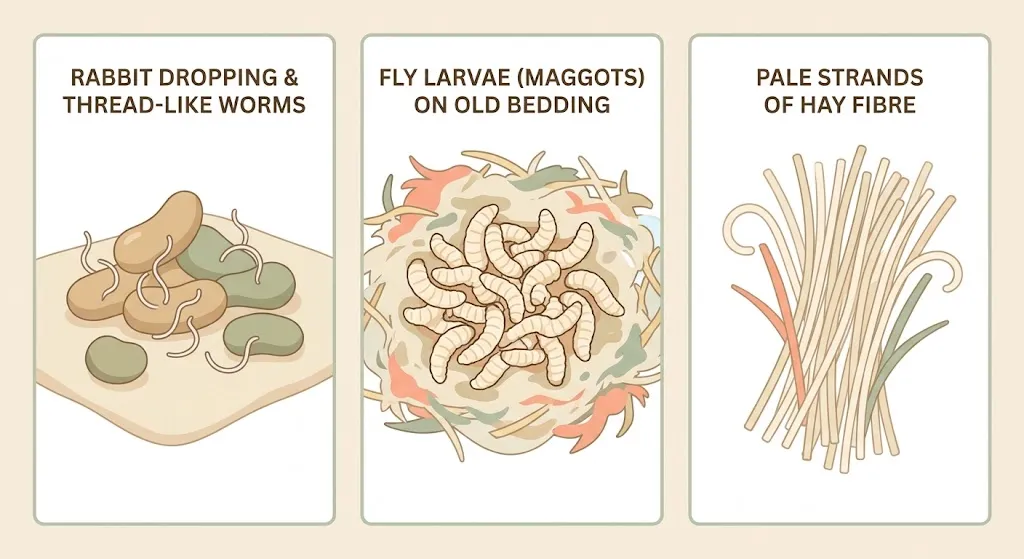
This is the distinction that matters most. Pinworms come out inside fresh droppings. Maggots hatch from fly eggs laid on old droppings, wet bedding or a dirty bottom, and they are fatter, creamy white and segmented.
Finding maggots on your rabbit rather than in the tray is an emergency. Flystrike is the leading recorded cause of death in UK pet rabbits, according to RVC VetCompass research reported by Woodgreen Pets Charity. If you see maggots on your rabbit’s fur or skin, call your vet straight away.
What Do Rabbit Worms Look Like?
Rabbit worms usually look like tiny white threads on or in a fresh dropping, while most other “worms” owners find are maggots, fibre or caecotroph mucus. Use this table as a first check, then let your vet confirm.
| What you see | Likely cause | What to do |
|---|---|---|
| Tiny white threads on a fresh, normal-looking dropping | Pinworms | Book a non-urgent vet visit and take a fresh sample |
| Fat, creamy, segmented larvae in old droppings or bedding | Fly maggots in the environment | Clean out fully and check your rabbit’s bottom and fur at once |
| Larvae or eggs on your rabbit’s fur or skin | Flystrike | Emergency vet visit |
| Pale strands that do not move and look like hay | Undigested fibre or hair | Usually normal; monitor appetite and droppings |
| Soft swelling under the skin | Possible tapeworm cyst or abscess | Vet visit for examination |
Looking for rabbit worms pictures to compare? Your vet can confirm what you have found under a microscope, which is far more reliable than matching online photos.
How to Tell if a Rabbit Has Worms
The only reliable way to tell if a rabbit has worms is a faecal test by your vet, because many rabbits with worms look completely healthy. At home, these steps give your vet useful information:
- Check droppings soon after they are passed, in daylight, rather than old ones in the tray.
- Look at the area under the tail for redness, soiling or signs of scratching.
- Weigh your rabbit on kitchen scales and note any drop over a few weeks.
- Collect a few fresh droppings in a clean, sealed bag or pot for your vet.
- Note whether your rabbit grazes outside, meets other rabbits or lives with dogs or cats.
The Rabbit Welfare Association and Fund decision pathway for vets starts with exactly this: a faecal sample, then a decision based on how many eggs are found, the rabbit’s living situation and any clinical signs.
What Are the Symptoms of a Rabbit With Worms?
Most rabbits with a light worm burden show no symptoms at all. Signs usually appear with heavier burdens, in young rabbits or in rabbits that are already unwell.
| Milder rabbit worms symptoms | Signs that need a prompt vet visit |
|---|---|
| Scratching or biting at the bottom | Weight loss despite eating |
| Redness or irritation around the anus | Diarrhoea or a persistently dirty bottom |
| Visible worms on fresh droppings | Repeated bouts of gut stasis |
| Slightly scruffy coat | Signs of tummy pain, such as hunching or teeth grinding |
Weight loss, diarrhoea, recurrent gut stasis and abdominal pain are the clinical signs the Rabbit Welfare Association pathway uses to decide that treatment is needed. A dirty bottom also raises flystrike risk, so it should never be left.
Does Rabbit Poop Carry Worms?
Rabbit poop can carry pinworm eggs, but those eggs only infect other rabbits. Rabbits catch pinworms by eating droppings containing eggs, which is why reinfection is so easy, as VCA explains.
Eating droppings (caecotrophs) is normal and essential for rabbit digestion, so you cannot stop it. That is why a whole bonded group needs treating together and why cleaning matters as much as medicine.
The cross-species risk runs the other way. Dogs and foxes carry the adult tapeworms whose eggs rabbits can swallow, while dogs only catch these tapeworms by eating infected rabbit tissue, as the veterinary text on rabbit parasites describes. Keeping your dog on a regular worming plan and clearing fox mess from the garden protects your rabbit.
Rabbit Worms Treatment: What Do UK Vets Use?
The standard rabbit worms treatment in the UK is fenbendazole, usually as Panacur Rabbit paste, given only when your vet thinks it is needed. Panacur Rabbit is an 18.75% fenbendazole paste licensed for intestinal worms and Encephalitozoon cuniculi in rabbits, according to MSD Animal Health.
The licensed preventative course is a daily dose by bodyweight for 9 consecutive days, as set out by MSD Animal Health. It is sold without a prescription under the Small Animal Exemption Scheme, as listed by The Hay Experts, and typically costs around £6 to £10 per syringe at UK retailers.
How to give a rabbit worming paste safely
- Weigh first: the dose is based on bodyweight, so an accurate weight matters.
- Ask your vet to show you the graduations: owners often find the syringe markings confusing.
- Give it into the side of the mouth: slowly, so your rabbit can swallow.
- Finish the full course: stopping early can leave worms behind.
- Treat every rabbit in the group: partners reinfect each other through droppings.
Why UK and US dosing advice does not match
UK Panacur Rabbit is an 18.75% paste, while many US guides refer to 10% fenbendazole products. Copying US millilitre or “per pound” doses onto a UK syringe can lead to the wrong dose, so always follow the label in your hand or your vet’s instructions.
What not to use
- Dog, cat, horse or sheep wormers: strengths and ingredients differ, and some are unsafe for rabbits.
- Ivermectin for pinworms: the Vet Times review notes it is thought to be ineffective against rabbit pinworms.
- Home remedies: pumpkin seeds, garlic and diatomaceous earth have no proven effect on rabbit worms.
- Longer courses without advice: do not extend or repeat a course unless your vet asks you to.
Cleaning to stop reinfection
- Remove all droppings and bedding daily during treatment.
- Wash litter trays, bowls and hard surfaces with hot water and a rabbit-safe disinfectant.
- Empty and refill hay racks rather than topping up old hay.
- Move outdoor runs to fresh ground where possible.
Do Rabbits Need Routine Worming?
Most UK rabbit vets now recommend testing before treating rather than worming every rabbit on a schedule. This is where the advice can feel contradictory.
The Panacur Rabbit label recommends routine 9-day courses 2 to 4 times a year, as listed by retailers including VioVet. Yet the Rabbit Welfare Association pathway says indoor rabbits with no risk factors and a negative faecal test need no treatment.
The reason is that the paste does two jobs. Alongside worms, it is licensed to help control Encephalitozoon cuniculi, a microscopic parasite that is not a worm at all. A veterinary consensus review on E. cuniculi reports seroprevalence of up to 85% in rabbits, so some vets advise courses for E. cuniculi reasons even when worms are not a concern.
From a veterinary point of view, the sensible approach is risk-based. Ask your vet whether your rabbit’s lifestyle, health and companions justify a course, rather than worming by default.
Bringing Home a Rescue Rabbit: Should You Worm First?
Ask your vet to check droppings at your rescue rabbit’s first health check, before bonding with any existing rabbits. Rescues often come from groups, outdoor setups or unknown backgrounds, which are the exact situations where worms spread.
- Keep a newly adopted rabbit separate from your current rabbits for the first period your vet advises.
- Take a fresh faecal sample to the first vet appointment.
- If treatment is needed, treat the new rabbit and any future bonding partners together.
- Ask the rescue centre whether the rabbit has already been wormed or tested, and with what.
When to See a Vet
Contact your vet the same day if your rabbit stops eating or pooping, and immediately if you see maggots on your rabbit. Book a routine appointment for anything else on this list.
- Emergency: maggots or eggs on fur or skin, no droppings for several hours, refusing food, collapse.
- Prompt visit: weight loss, diarrhoea, a dirty bottom that keeps recurring, signs of tummy pain.
- Routine visit: worms seen on fresh droppings in an otherwise bright, eating rabbit.
Rabbits hide illness well, so the PDSA advises checking them every day, paying particular attention to their bottoms.
FAQs
Can indoor rabbits get worms?
Yes, but it is much less likely. Indoor rabbits mainly pick up worms from contaminated hay or greens, a new rabbit joining the household, or time spent grazing outdoors. The Rabbit Welfare Association pathway treats indoor-only rabbits with no risk factors as low risk, so a faecal test is a better first step than routine worming if you are worried.
Can humans catch worms from rabbits?
You cannot catch rabbit pinworms, because they only live in rabbits. Rabbits do not carry the adult dog and fox tapeworms either; they only host the larval stage. Washing your hands after cleaning the hutch or litter tray is still good hygiene, especially for children, but rabbit worms themselves are not a risk to your family.
Can dogs get worms from eating rabbit poop?
Dogs cannot catch rabbit pinworms from droppings, because the pinworm only infects rabbits. The real risk for dogs is eating rabbit tissue, which can pass on tapeworm larvae from tapeworm cysts. Keep dogs that hunt or scavenge rabbits on a regular worming plan agreed with your vet, which also protects any pet rabbits sharing your garden.
How often should I worm my rabbit?
There is no fixed schedule that suits every rabbit. The product label suggests courses up to four times a year, but many UK rabbit vets now prefer to test droppings first and treat only when worms are confirmed or the risk is high. Grazing, group living and contact with new rabbits all raise the case for treatment, so agree a plan with your vet.
Do baby rabbits need worming?
Not automatically. Young rabbits can be more affected by a heavy worm burden, so a kit that is thin, has diarrhoea or is not growing well should see a vet promptly. If you are adopting a young rabbit, ask the rescue what treatment it has already had and take a fresh faecal sample to its first health check.
Can I use a dog or cat wormer on my rabbit?
No, not unless your vet prescribes it. Dog and cat wormers come in different strengths and some contain ingredients that are not safe for rabbits. Use a rabbit-licensed product such as Panacur Rabbit paste, follow the label or your vet’s instructions exactly, and ask your vet before combining any wormer with other medication.
Do rabbit pinworms go away on their own?
Light pinworm burdens often cause no harm and may not need treatment, but they rarely disappear on their own because rabbits keep reinfecting themselves by eating droppings. If your rabbit is well, your vet may suggest monitoring. If there are symptoms, a full course for every rabbit in the group plus thorough cleaning is the usual answer.
Conclusion
Rabbit worms sound alarming, but for most pet rabbits they are uncommon, mild and easy to treat. Small white worms on fresh rabbit poop are usually pinworms, while maggots on your rabbit are an emergency that needs a vet straight away.
The safest approach is simple: take a fresh sample to your vet, treat only when it is needed, treat the whole group together and keep the living area clean. That way you avoid both missed infections and unnecessary medicine.
If you are thinking of giving a rabbit a second chance, UK rescues have many waiting for homes. Find a rabbit rescue centre near you and ask about each rabbit’s health checks before you bring them home.
Medical Disclaimer: This article is for informational purposes only and does not replace professional veterinary advice. Always consult your vet before changing your pet’s diet, medication or care routine.