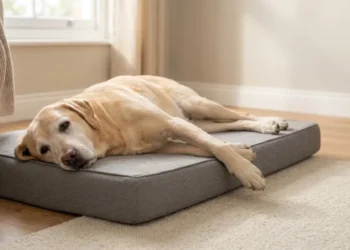


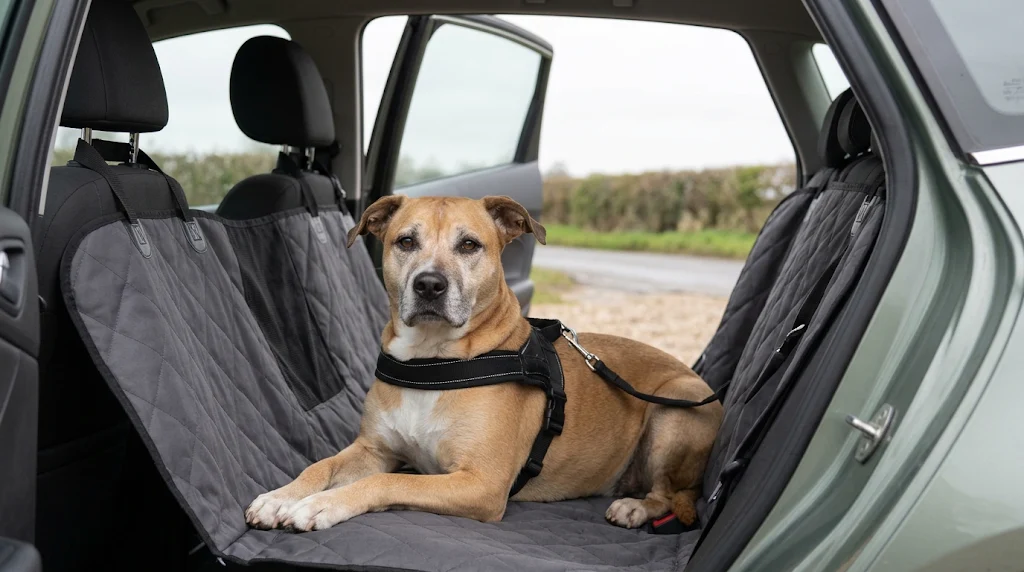
The first car journey with a rescue dog tells you a lot. Some settle straight down. Others pace the back seat, slide into the footwell on every roundabout, and arrive shaking. A proper setup in the back of the car fixes most of that, and it keeps the mud off your upholstery too.
This guide compares dog car beds that UK buyers can actually order, including hammocks, booster seats, boot liners and crash tested crates. It also explains something most roundups skip: which of these products protect your dog in a crash, and which only keep your car clean.
Affiliate disclosure: Pet Rescue Blog may earn a small commission if you buy through some links on this page, at no extra cost to you. Our picks are based on published specifications, UK availability and veterinary guidance, not on payments from brands.
Key Takeaways
- A dog car bed or hammock is a comfort and containment product. It is not a crash restraint, and no booster seat, car bed or hammock currently holds Center for Pet Safety certification.
- Center for Pet Safety certifies only three categories of travel product: safety harnesses, pet travel carriers and travel crates.
- Rule 57 of the Highway Code says dogs must be suitably restrained in a vehicle, and lists a seat belt harness, pet carrier, dog cage or dog guard as ways of doing it.
- Careless and inconsiderate driving carries an unlimited fine, 3 to 9 penalty points and possible disqualification, which is the route an unrestrained dog usually leads to.
- PDSA warns that boot and luggage guards protect your passengers in an accident but will not protect your pet.
- Budget hammocks start at roughly £20, mid-range padded hammocks run about £40 to £60, and crash tested crates begin around £250.
- Purpose-built dog car beds and boosters are small-dog products. Large dogs are better served by a boot bed, a full-seat hammock or a crash tested crate.
Quick Answer
The best dog car beds and hammocks depend on your dog’s size and whether you travel on the back seat or in the boot. These four picks cover the most common UK setups and budgets.
| Category | Recommendation | Approximate UK Price |
|---|---|---|
| Best Overall | EB Rear Seat Hammock | From around £60 |
| Best Budget | EB Animal Basics Waterproof Hammock | From around £20 |
| Best for Small Dogs | Kurgo Heather Booster Seat | Around £55 |
| Best Premium (Crash Tested) | 4pets Caree with ISOFIX | From around £270 |
Prices vary by retailer, size and sale period. Check the retailer before buying.
Dog Car Beds, Hammocks and Boosters: What Is the Difference?
Dog car beds, hammocks and boosters solve three different problems, even though shops often file them together. Knowing which one you are shopping for saves money and avoids buying something your dog cannot physically fit in.
- Dog car bed or pod: a padded, walled nest that sits on the seat and gives a small dog somewhere enclosed to settle. Most convert into a bed for use outside the car.
- Dog car hammock: a sheet of waterproof fabric slung between the front and rear headrests. It covers the whole back seat and blocks the footwell gap so a dog cannot slide down.
- Booster seat: a raised, structured seat that lifts a small dog high enough to see out of the window, which can help with travel sickness.
- Boot bed or boot liner: a padded, waterproof cover for the boot floor and bumper, usually the only realistic option for a big dog.
- Crash tested crate or carrier: a rigid enclosure anchored to the vehicle, and the only category with independent crash certification behind it.
One warning from PDSA applies to the boot setup in particular. The charity notes that boot and luggage guards protect your passengers in an accident but will not protect your pet. A guard keeps a dog out of the cabin. It does nothing to stop the dog being thrown forward inside the boot.
Are Dog Hammocks Safe? The Honest Answer
Dog hammocks are safe in the sense that they stop a dog falling into the footwell and sliding around on corners, but they are not a crash restraint and should never be treated as one. The same is true of car beds, pods and booster seats.
The Center for Pet Safety, the independent American body that crash tests pet travel products, certifies three categories only: safety harnesses, pet travel carriers and travel crates. There is no certified booster seat, no certified car bed and no certified hammock, because none has passed.
PDSA puts the underlying problem plainly: unlike human safety devices, there is no legal requirement for pet travel products to be crash tested, so it is difficult to know how much protection any of them would really give. PDSA names the SleepyPod Clickit harness, the SleepyPod carrier and the Gunner Kennel GI Intermediate as products that have been tested and certified by the Center for Pet Safety.
This leads to a simple rule that runs through the rest of this guide. Use the hammock or bed for comfort and cleanliness, and clip your dog into a proper harness that connects to the car’s own seat belt. The two work together. Neither replaces the other.
What Does UK Law Say About Dogs in Cars?
UK law on dogs in cars sits in the Highway Code rather than in a dedicated offence. Rule 57 states that when in a vehicle you should make sure dogs or other animals are suitably restrained so they cannot distract you while driving or injure you, or themselves, if you stop quickly. It lists a seat belt harness, pet carrier, dog cage or dog guard as ways of restraining animals in cars.
Rule 57 carries no “MUST” and cites no legislation beneath it, so breaching it is not an offence in itself. What it does is feed into other offences. If an unrestrained dog distracts you, the charge is usually careless and inconsiderate driving.
The Highway Code’s own penalty table sets out what that means. Careless and inconsiderate driving carries an unlimited fine, discretionary disqualification and 3 to 9 penalty points. A lesser charge, failing to have proper control of the vehicle or a full view of the road, carries a £1,000 fine and 3 points.
You will see a £5,000 figure quoted on a great many pet and motoring websites. Treat it with caution. The cap on that level of fine was removed, so the maximum for careless driving is now unlimited rather than a fixed sum.
Insurance is the other consideration. PDSA notes that many car insurance policies require you to restrain your pet, that a loose pet could breach your policy terms, and that it may also affect a pet insurance claim if your dog is injured. If you are reviewing cover, our guide to lifetime pet insurance explains how UK policy types differ.
What to Look For in a Dog Car Bed or Hammock
The best dog car beds and hammocks share six features, whichever category you buy from. Use these as a checklist before you order, because returns on used pet bedding are often refused on hygiene grounds.
- Seat belt access: the cover needs openings or slits so you can still reach the belt buckles and clip your dog’s harness to the car. Without them you are forced to choose between the cover and the restraint.
- Measured fit: measure the width of your back seat or the floor of your boot before buying. Hammocks that are too narrow leave gaps at the sides where mud gets through.
- Non-slip underside: a cover that slides turns into a hazard every time your dog shifts position. Mesh or rubberised backing holds it in place.
- Side flaps: most damage happens as a dog climbs in and out, not while sitting. Flaps that cover the seat edges and door cards take that wear.
- Washable and waterproof: a machine washable cover over a waterproof layer is the combination that lasts. Waterproof alone becomes unpleasant quickly.
- Honest weight limit: boosters and pods list a maximum weight. Treat it as a hard limit, not a guide, and measure your dog rather than guessing from breed.
Top Picks: Dog Car Beds, Hammocks and Crates
These picks cover every category of dog car bed sold in the UK, grouped by the problem they solve. Each has at least one real drawback, because no single product suits every dog and every car.
1. EB Animal Basics Waterproof Hammock
The EB Animal Basics Waterproof Hammock is the cheapest way to get full back seat coverage, listed at Travelling with Pets from around £20. It is a one size design from Emanuele Bianchi, whose covers use anti-slip mesh and neoprene corner anchors to stay put on the seat.
Best For: First-time buyers and anyone testing whether their dog will settle on a hammock
Key Features:
- Waterproof fabric across the full rear bench
- One size fit for most vehicles
- Anti-slip mesh backing
- Neoprene corner anchors
Pros:
- Lowest entry price of any full hammock in this guide
- Easy to take out and wash between muddy walks
Cons:
- No padding, so it adds protection rather than comfort
Price Range: From around £20 (prices vary by retailer and size)
2. EB Animal Basics Velvet Hammock
The EB Animal Basics Velvet Hammock trades the plain waterproof finish for plush velvet, and is listed from around £45 at Travelling with Pets. It suits dogs that will lie down for the journey rather than stand and watch out of the window.

Best For: Dogs that settle and sleep on longer journeys
Key Features:
- Velvet upper surface over a protective base
- One size rear seat fit
- Range of colour options
- Anti-slip mesh and corner anchors
Pros:
- Noticeably more comfortable than a bare waterproof sheet
- Looks less utilitarian in a family car
Cons:
- Velvet holds dog hair more stubbornly than smooth fabric
Price Range: From around £45 (prices vary by retailer and size)
3. EB Rear Seat Hammock
The EB Rear Seat Hammock is the XL option in the range, listed from around £60 at Travelling with Pets. Emanuele Bianchi uses thicker material than most suppliers, which is the main reason this sits at the top of the hammock pricing.

Best For: Larger cars, estates and SUVs with a wide rear bench
Key Features:
- XL sizing for wider rear benches
- Heavier fabric weight than budget covers
- Anti-slip mesh base
- Neoprene corner belts to hold position
Pros:
- Thicker material stands up to claws better over time
- Covers the full bench including the sides
Cons:
- Takes up the whole back seat, so passengers cannot share it
Price Range: From around £60 (prices vary by retailer and size)
4. EB Rear Seat Protector
The EB Rear Seat Protector is a flat bench cover rather than a slung hammock, listed in XL from around £45 at Travelling with Pets. It protects the seat without closing off the footwell, which suits dogs that prefer to lie in the footwell by choice.

Best For: Owners who want seat protection without walling off the rear footwell
Key Features:
- Flat bench cover design
- XL sizing
- Anti-slip mesh backing
- Neoprene corner anchors
Pros:
- Leaves the footwell open for a dog that likes to lie low
- Less bulky to fit and remove than a full hammock
Cons:
- Does not block the footwell gap, so a dog can still slide down on braking
Price Range: From around £45 (prices vary by retailer and size)
5. EB Animal Basics Velvet Rear Seat Cover
The EB Animal Basics Velvet Rear Seat Cover is the mid-price bench option, listed from around £39 at Travelling with Pets. It covers the rear bench in the same plush velvet as the hammock version without the headrest straps.

Best For: Short, regular trips such as the school run or the vet
Key Features:
- Velvet rear bench cover
- One size fit
- Choice of colourways
- Anti-slip mesh and corner belts
Pros:
- Quick to fit and remove between journeys
- Comfortable surface for a dog that lies down
Cons:
- Offers no side or door protection
Price Range: From around £39 (prices vary by retailer and size)
6. Kurgo Heather Booster Seat
The Kurgo Heather Booster Seat is a padded, structured seat that lifts a small dog high enough to see out, listed at around £56 at GS Equestrian. It installs on a bucket seat and collapses flat for storage.

Best For: Small dogs that get travel sick or anxious at seat level
Key Features:
- Padded booster with internal structure
- Installs on any bucket seat
- Collapses for storage
- Designed for use with a tether and harness
Pros:
- Raised view can reduce travel sickness in small dogs
- Keeps a lap dog off the driver
Cons:
- Weight limits rule out anything beyond a small breed
- Kurgo advises replacing a booster seat after any accident, as you would a child seat
Price Range: Around £56 (prices vary by retailer and size)
7. Kurgo Enhanced Strength Tru-Fit Smart Harness
The Kurgo Enhanced Strength Tru-Fit Smart Harness is the restraint that should sit underneath whichever bed or hammock you choose, listed from around £23 at GS Equestrian. Rule 57 names a seat belt harness first among acceptable restraints.
Best For: Every dog travelling on a seat rather than in a crate
Key Features:
- Car harness with seat belt connection
- Multiple sizes from XS upwards
- Doubles as a walking harness
- Pairs with a seat belt tether
Pros:
- Cheap relative to the protection it adds
- Works with any hammock that has belt access openings
Cons:
- Not Center for Pet Safety certified, unlike the SleepyPod Clickit named by PDSA
Price Range: From around £23 (prices vary by retailer and size)
8. 4pets Caree
The 4pets Caree is a crash tested carrier for small dogs that fits onto a passenger seat, listed from around £270 at Travelling with Pets. It fixes with the seat belt, or with an ISOFIX accessory that uses the same anchor points as a child car seat.

Best For: Small dogs whose owners want genuine crash protection rather than containment
Key Features:
- Crash tested to TÜV standards
- Seat belt or ISOFIX mounting
- Fits front or rear passenger seats
- Quick to fit and remove
Pros:
- The only seat-mounted option here with crash testing behind it
- ISOFIX fitting removes the guesswork from installation
Cons:
- Costs several times more than a hammock
- Small dogs only, and the ISOFIX weight limit is lower again
Price Range: From around £270 (prices vary by retailer and size)
9. 4pets PRO Dog Cage
The 4pets PRO is a crash tested boot cage available in thirteen sizes, listed from around £250 at Travelling with Pets. The retailer describes a patented back panel, the Impact Protection System, that expands to absorb the energy of a dog thrown against it and then releases it in a controlled way.

Best For: Medium and large dogs travelling in the boot of a hatchback, estate or SUV
Key Features:
- Crash tested to TÜV standards
- Thirteen sizes to suit different boot shapes
- Impact Protection System back panel
- Insulated walls and roof
Pros:
- Addresses the gap PDSA identifies, where a boot guard protects people but not the dog
- Size range covers most UK family cars
Cons:
- Takes up boot space permanently unless you remove it
- Far more expensive than a boot liner
Price Range: From around £250 (prices vary by retailer and size)
10. Thule Allax Dog Cage
The Thule Allax is the premium crash tested boot cage, listed from around £425 at Travelling with Pets in ten sizes. It is built mostly from aluminium and steel, with a steel back panel that includes an escape hatch.
Best For: Owners who travel constantly and want a permanent boot installation
Key Features:
- Crash tested to TÜV standards
- Ten sizes, variable length design
- Aluminium and steel construction
- Steel back panel with escape hatch
Pros:
- Escape hatch matters if the boot is blocked after a collision
- Variable length adjusts to the boot you have
Cons:
- The most expensive option in this guide by a wide margin
- Heavy to lift in and out
Price Range: From around £425 (prices vary by retailer and size)
Comparison Table
This table compares all ten dog car travel products side by side, so you can match one to your dog’s size and your budget.
| Product | Best For | Key Feature | Price Range |
|---|---|---|---|
| EB Animal Basics Waterproof Hammock | Budget full coverage | Waterproof rear bench | From around £20 |
| EB Animal Basics Velvet Hammock | Dogs that lie down | Plush velvet surface | From around £45 |
| EB Rear Seat Hammock | Large cars and SUVs | XL, heavier fabric | From around £60 |
| EB Rear Seat Protector | Open footwell setups | Flat bench cover | From around £45 |
| EB Velvet Rear Seat Cover | Short regular trips | Quick to fit | From around £39 |
| Kurgo Heather Booster Seat | Small dogs, travel sickness | Raised window view | Around £56 |
| Kurgo Tru-Fit Smart Harness | Any dog on a seat | Seat belt restraint | From around £23 |
| 4pets Caree | Small dogs, real protection | Crash tested, ISOFIX | From around £270 |
| 4pets PRO Dog Cage | Medium and large dogs | Impact Protection System | From around £250 |
| Thule Allax Dog Cage | Frequent travellers | Escape hatch, ten sizes | From around £425 |
Buying Guide:
What Are the Best Car Bed Options for Large Dogs?
The best car bed options for large dogs are a boot bed, a full-width rear seat hammock, or a crash tested boot cage. Purpose-built dog car beds, pods and booster seats are almost all designed for small breeds, with weight limits that rule out a Labrador or a German Shepherd before you start.
This is the single biggest mismatch in the category. If you search for large dog car beds and land on a page of padded pods, check the stated maximum weight before you read any further. For a dog over roughly 20kg, your realistic choices are the boot or a full rear bench, and the 4pets PRO cage range covers thirteen boot sizes if you want crash testing with it.
How Do You Fit a Dog Car Seat or Hammock?
You fit a dog car seat or hammock by anchoring it to the headrests first, then securing the base, then checking the seat belt openings are still usable. Work in that order and the cover sits flat instead of bunching.
- Loop the rear straps over the back seat headrests and tighten until the fabric is taut.
- Loop the front straps over the front seat headrests to form the hammock wall across the footwell.
- Press the anti-slip base flat against the bench and fit any corner anchors or under-seat cords.
- Locate the seat belt openings and pull the buckles through before your dog gets in.
- Sit in the back yourself and push down hard. If the cover slides, retighten before you drive.
How Do You Seat Belt a Dog in a Car?
You seat belt a dog in a car by fitting a car harness, then connecting that harness to the vehicle’s own seat belt with a short tether. Rule 57 of the Highway Code names a seat belt harness as one of the acceptable ways to restrain an animal in a vehicle.
Never clip a tether to a collar. In a sudden stop the entire load goes through your dog’s neck. The connection point belongs on a harness that spreads force across the chest, and the tether should be short enough that your dog cannot build up speed before it goes tight. A direct to seat belt tether of this kind costs under £10.
Can a Dog Sit in the Front Seat of a Car?
A dog can legally sit in the front seat of a car in the UK provided it is suitably restrained, but the back seat or boot is the better choice. Rule 57 does not specify a position, only that the animal cannot distract or injure you.
PDSA gives the practical reason to keep dogs out of the front: a loose pet could distract the driver and could even get in the way of the steering wheel or the brake pedal. If the front seat is genuinely your only option, restrain the dog properly and remember that passenger airbags are designed for adult humans, not animals.
Where Should Your Dog Travel in Hot Weather?
Your dog should travel wherever you can actually control the temperature, which is often not the back of the car. PDSA warns that although most cars have good air conditioning in the front, the back seat or boot can heat up very quickly and become dangerously warm, especially for a pet in a carrier with less airflow.
PDSA advises adjusting the fans towards the back, opening windows, and removing the parcel shelf, using a pet carrier or boot guard to keep your pet secure instead. The charity also notes that when it is 22°C outside, the temperature inside a car can reach 47°C within an hour, and that a dog’s internal body temperature exceeding 41°C can be fatal.
How Often Should You Clean Dog Car Seat Covers?
Clean dog car seat covers whenever they come back wet or muddy, and run a full machine wash at least monthly for a dog that travels several times a week. Damp fabric left in a warm car is what causes the smell that owners usually blame on the dog.
Shake the cover out after every muddy walk and let it dry fully before refitting. Check the care label for the maximum wash temperature, and replace any cover whose waterproof backing has started to crack, because once that layer fails the seat underneath is no longer protected.
Does Your Dog Need Help Settling in the Car?
Some dogs need behavioural help rather than better bedding. PDSA advises introducing a dog to the parked car first, building up to short trips, and ending journeys with something enjoyable such as a treat or a walk so the association stays positive.
If your dog is reactive to road noise rather than to movement, that is a different problem again. Our guide to quiet ears for dogs covers options for noise sensitivity, including during travel. PDSA also suggests speaking to your vet about medication if your dog is sick in the car even on an empty stomach.
FAQs
Are dog car hammocks safe?
Dog car hammocks are safe for containment but are not crash restraints. The Center for Pet Safety certifies only harnesses, carriers and travel crates, and no hammock has been certified. Use a hammock alongside a car harness clipped to the vehicle’s seat belt rather than on its own.
Do dog hammocks work for nail trimming?
Car hammocks do not work for nail trimming. The product people mean here is a grooming hammock or sling, which suspends a dog in the air so its paws hang free, and that is a completely different item from a car seat hammock. See our guide to dog nail trimming for the actual technique.
What is the best dog car bed for a large dog?
The best dog car bed for a large dog is a boot bed or a crash tested boot cage, not a padded pod. Nearly all purpose-built car beds and boosters have weight limits that suit small breeds only, so owners of big dogs should shop the boot category instead.
Is it illegal to drive with an unrestrained dog in the UK?
Driving with an unrestrained dog is not a standalone offence in the UK, but it can lead to one. Rule 57 of the Highway Code is advisory, and enforcement normally comes through careless and inconsiderate driving, which carries an unlimited fine, 3 to 9 penalty points and possible disqualification.
Can an unrestrained dog invalidate my car insurance?
An unrestrained dog can affect a car insurance claim. PDSA notes that many policies require you to restrain your pet and that a loose pet could breach your policy terms, which may leave you paying for repairs yourself. It may also affect a pet insurance claim if your dog is injured.
How much do dog car beds cost in the UK?
Dog car beds and hammocks cost roughly £20 to £60 in the UK. Budget waterproof hammocks start around £20, padded and velvet versions run about £39 to £60, booster seats sit near £55, and crash-tested crates begin at about £250.
Do I still need a harness if I use a hammock?
Yes. A hammock stops your dog sliding into the footwell but does nothing to hold them in place during a collision. Choose a hammock with seat belt openings so you can clip a car harness to the vehicle’s belt underneath it.
Which dog travel products are actually crash tested?
Harnesses, carriers and travel crates are the only categories with independent crash certification. The Center for Pet Safety certifies products in those three groups, and PDSA names the SleepyPod Clickit harness, the SleepyPod carrier and the Gunner Kennel GI Intermediate among certified options.
Related Articles
- Top 10 Orthopedic Dog Beds for Senior Dogs (UK Guide)
- Quiet Ears for Dogs: Best Options for Anxiety and Noise Relief
- Best Dog Dryers UK: Top Picks for Home Grooming
- Dogs Trust: An Independent Guide to Adoption and Rehoming Centres
- How to Adopt a Dog in the UK: Your Complete Step-by-Step Guide
Conclusion
Most UK dog owners need two things in the car, not one. A hammock or boot bed keeps the mud and hair off your seats and stops your dog sliding about, and a harness clipped to the seat belt is what actually holds them in a collision. Buying the first without the second is the mistake this guide exists to prevent.
For most people the budget waterproof hammock plus a car harness is the sensible starting point, at well under £50 together. If you drive long distances with your dog every week, a crash tested crate is the only category with independent testing behind it, and the price gap reflects that difference honestly.
If you are still deciding whether to bring a dog home, the car setup is one of the smaller costs ahead of you. UK charities including Dogs Trust have dogs of every size waiting, and our guide on how to adopt a dog in the UK walks through the process from application to that first journey home.
Insurance Disclaimer: This article is general information, not financial advice. Policy prices and cover vary by provider, pet, and postcode. Compare policies and read the terms carefully, or speak to an FCA-regulated adviser.
Safety Disclaimer: This article is general guidance, not legal advice, and product descriptions reflect manufacturer and retailer claims. No dog car bed, booster seat or hammock is a certified crash restraint. Always check the Highway Code and your own insurance policy terms.