

Every UK rescue centre has dogs whose problems began on the day they were bought: a puppy farmed in a shed, sold from a car park, or “rehomed” by a seller who switched off their phone the moment the money cleared. Learning how to find a reputable dog breeder in the UK is the single best thing you can do to avoid adding to that story.
The good news is that UK buyers have more tools than ever to check a breeder properly. Council licence registers, star ratings, public health test databases and a free, legally binding contract all exist, and most buyers never use them.
This guide shows you where reputable breeders are actually found, how to verify one before you hand over a penny, and what the rules look like in England, Scotland, Wales and Northern Ireland.
Key Takeaways
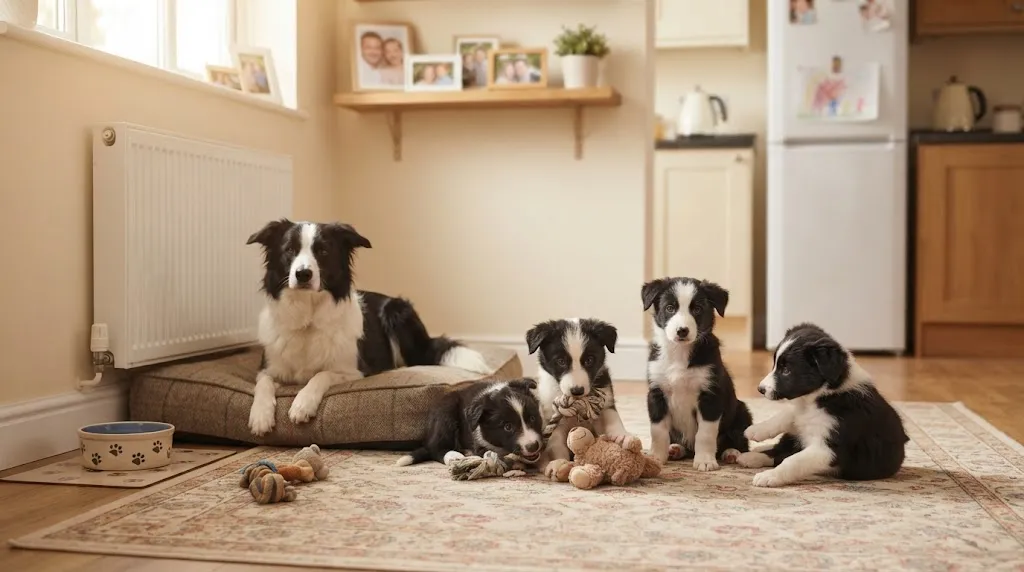
- A reputable breeder will always let you see the puppy with its biological mother in the home where it was born, and licensed breeders in England must do this by law.
- The Kennel Club Assured Breeders scheme has closed, so any breeder still using it as their main selling point is working from out-of-date information.
- The Royal Kennel Club’s Find a Breeder directory lists breeders who meet its Good Practice health standard, but the club says a listing is not an endorsement.
- Any breeder who needs a council licence must show the licence number and issuing council in their adverts, and you can check both with the council.
- Health test results for Kennel Club registered parents can be looked up for free on the Health Test Results Finder, so you never need to rely on “vet checked”.
- The free Puppy Contract is legally binding and gives you far stronger protection than a verbal promise, especially when buying from a private seller.
- Good breeders usually have a waiting list, so expect to wait weeks or months for the right litter.
Quick Answer
To find a reputable dog breeder in the UK, start with your breed club and the Royal Kennel Club Find a Breeder directory, not social media adverts. Then verify the breeder: check their council licence and star rating if they need one, look up both parents’ health test results online, visit the puppy with its mother at the breeder’s home, and only buy using the Puppy Contract. If any check fails, walk away.
What Makes a Dog Breeder Reputable in the UK?
A reputable breeder puts the health and temperament of their dogs ahead of profit, and can prove it with paperwork you can check yourself. Friendliness and nice photos tell you very little; evidence tells you a lot.
In practice, a reputable UK breeder will:
- Breed one or two breeds they know deeply: they can explain the breed’s common health problems, temperament and exercise needs without hesitating.
- Health test both parents: using the schemes recommended for the breed, with results you can verify.
- Raise puppies in a home or well-run kennel: with the mother present and a clear socialisation routine.
- Follow the law: no puppy leaves before 8 weeks, every puppy is microchipped and registered to the breeder first, and a licence is held where one is required.
- Vet you as a buyer: the Defra guidance on buying a cat or dog says a responsible seller will not rush you and should be assessing your suitability as an owner.
- Stay involved for life: they offer a written contract and will take the dog back if your circumstances change.
One point surprises many buyers. Not every good breeder needs a licence. A hobby breeder with a single litter may be breeding legally and responsibly without one, which is why the checks in this guide focus on evidence rather than any single badge.
Where Can You Find a Reputable Dog Breeder in the UK?
The best places to start are breed clubs, the Royal Kennel Club Find a Breeder directory and personal recommendations from vets and owners, because each of these sources has some accountability built in. Open classified sites and social media sit at the bottom of the list.
| Where to look | Why it helps | What to watch for |
|---|---|---|
| Breed clubs and breed councils | Members usually health test to the breed’s recommendations, and many clubs keep litter lists or a code of ethics. | Ask the club secretary how members are checked; a listing alone is not a guarantee. |
| Royal Kennel Club Find a Breeder | Breeders must meet the RKC Good Practice health standard where one exists for the breed, and you can join waiting lists before a litter is born. | The RKC states that inclusion is not an endorsement, so you still need to visit and verify. |
| Royal Kennel Club Find a Puppy | Lists registered litters that are available or due. | Registration records parentage; it does not inspect the breeder’s premises. |
| Your vet, trainer or groomer | They meet local breeders’ dogs and often know who has healthy, well-socialised litters. | Ask why they recommend someone, not just who. |
| Dog shows, field trials and breed events | You can meet adult dogs from a breeder’s lines and see their temperament in person. | Show success says little about health testing, so check results separately. |
| PAAG-engaged classified sites | Gumtree, Pets4Homes, Preloved, Petify and Find Your Paws have committed to the PAAG advertising standards. | Adverts are still placed by sellers; every check below still applies. |
| Social media groups and marketplaces | Can connect you with genuine owners for recommendations. | PAAG advises against buying pets directly through social media, as adverts are hard to police. |
Breed clubs and breed councils
Every recognised UK breed has at least one breed club, and many have a breed council that links several clubs together. FOUR PAWS UK recommends breed councils as one of the first places to look, because they can point you to trusted breeders and to club events where you can meet the breed.
You can search for clubs by breed and region using the Royal Kennel Club club finder. Breed club websites often publish the health tests their members are expected to carry out, which gives you a ready-made checklist.
The Royal Kennel Club Find a Breeder directory
The Find a Breeder directory lets you search by breed and region, contact breeders before a litter is planned and join waiting lists. According to the Royal Kennel Club’s launch announcement, listed breeders are reviewed against RKC criteria, including its Good Practice health standard and breeding only breed standard colours.
Read the small print, though. The directory page itself states that it is a listing service only, that the RKC does not register breeders, and that inclusion is not an endorsement or guarantee. Treat it as a shortlist, not a verdict.
What happened to Kennel Club Assured Breeders?
Many guides still tell buyers to look for a Kennel Club Assured Breeder. That scheme no longer exists. The Kennel Club announced the closure of the Assured Breeders scheme, noting that only five percent of registered puppies were bred by scheme members.
If a breeder’s website still leads with an Assured Breeder logo, it does not mean they are a bad breeder. It does mean you should ask what standards they follow instead, and verify their health testing yourself.
Personal recommendations
Owners of healthy, confident adult dogs of your chosen breed are one of the best sources you have. Ask them where their dog came from, whether the breeder kept in touch and whether they would buy from that breeder again. Then run the same checks on that breeder as you would on anyone else.
How Do You Check a Dog Breeder’s Licence?
Ask for the licence number and the name of the council that issued it, then confirm both with that council, which can also tell you the breeder’s star rating. In England, licensed breeders must put this information in their adverts, so a missing licence number on a busy breeder’s listing is a warning sign.
The Defra statutory guidance on dog breeding licences says any advert from a licensed breeder must include the licence number, the issuing local authority, a recognisable photo of the puppy and the puppy’s age. The licence holder’s name and number must also be shown on any website they use for the business.
- Find the right council. Use the gov.uk council finder with the breeder’s postcode.
- Search the council’s public register. Many councils publish animal activity licences online, often with the star rating and expiry date.
- Phone or email if there is no online register. Ask the licensing or environmental health team to confirm the licence number, the address it covers and its expiry date.
- Check the address matches. A licence covers specific premises, so the puppies should be at the address on the licence.
What does a breeder’s star rating mean?
In England, licensed breeders receive a rating from one to five stars after inspection. The Defra guidance explains that breeders meeting the higher standards receive a 4 or 5 star rating and a longer licence. The table below shows how some of those higher standards compare with the legal minimum.
| Standard | Legal minimum (licensed breeders, England) | Higher standard (4 or 5 stars) |
|---|---|---|
| Minimum age of mother at mating | 12 months | 18 months |
| Maximum litters per mother | 6 | 4 |
| Caesarean sections | No mating after 2 | No breeding after 1 |
| Health screening of parents | Must not breed dogs likely to pass on poor health | Must use the validated health schemes for the breed and follow their advice |
| Vet check of each puppy before sale | Not required | Required, with proof available to the buyer |
| Puppy contract | Not required | Required |
Source: Defra dog breeding licensing statutory guidance.
A one or two star rating is not automatically a red flag, as newer licences and minor admin issues can affect the score. It is, however, a good reason to ask the breeder why.
What if the breeder does not have a licence?
In England, a licence is needed by anyone breeding three or more litters in 12 months and selling any puppies, or anyone breeding and advertising a business of selling dogs, according to the gov.uk dog breeding licence page. Someone with one family pet and one planned litter may not need one.
That is fine, as long as everything else checks out. Be wary, though, if an “unlicensed hobby breeder” has several litters advertised, more than one breed for sale, or adverts across many sites. The Defra guidance lists exactly these patterns as signs of a business that should be licensed.
Do the Rules Differ in Scotland, Wales and Northern Ireland?
Yes. All four UK nations license larger breeders, but the thresholds differ, so check the rules where the breeder lives rather than where you live. This matters if you are travelling across a border to collect a puppy.
| Nation | When a breeder needs a licence | Who issues it |
|---|---|---|
| England | Breeding 3 or more litters in 12 months and selling any puppies, or breeding and advertising a business of selling dogs | Local council |
| Scotland | Breeding 3 or more litters in 12 months, whether or not puppies are sold | Local council |
| Wales | Keeping 3 or more breeding bitches and breeding, advertising or supplying 3 or more litters in 12 months, or advertising a business of breeding or selling puppies | Local council |
| Northern Ireland | Keeping 3 or more breeding bitches and breeding, advertising or supplying 3 or more litters in 12 months, or advertising a business of breeding or selling puppies | District council |
Sources: gov.uk (England), Scottish Government, Animal Welfare (Breeding of Dogs) (Wales) Regulations 2014, DAERA (Northern Ireland).
Scotland has gone a step further for buyers. The Welfare of Dogs (Scotland) Act 2025 requires Scottish Ministers to publish a code of practice for anyone acquiring a dog, including seeing a puppy with its mother where practicable and completing a certificate signed by both buyer and seller.
How Do You Check a Breeder’s Health Testing?
Find out which tests your breed needs, ask for the results for both parents, and then look them up yourself on the Royal Kennel Club Health Test Results Finder. This takes about ten minutes and is the clearest way to tell a careful breeder from a careless one.
- Look up your breed’s tests. The Royal Kennel Club Health Standard brings together the recommended tests for each breed in one place.
- Ask for the parents’ registered names. A breeder who is proud of their testing will give these without hesitation.
- Search the results. The Health Test Results Finder shows DNA tests, health scheme results and inbreeding figures for any RKC registered dog.
- Ask about anything missing. A good breeder can explain every gap, for example a stud dog tested abroad.
The main UK health screening schemes are run by the British Veterinary Association and the Royal Kennel Club. The BVA Canine Health Schemes cover hip dysplasia, elbow dysplasia, inherited eye disease and Chiari malformation/syringomyelia. For hips, lower scores are better; for elbows, grade 0 is the best result. Our guide to hip dysplasia in dogs explains why these scores matter for your puppy’s future.
If you are looking at a Pug, French Bulldog or Bulldog, ask about breathing grades too. The University of Cambridge Respiratory Function Grading Scheme grades dogs from 0 to 3 for BOAS, and advises that grade 3 dogs should not be bred from.
Do crossbreed and “designer” breeders need to health test?
Yes. A Cockapoo or Cavapoo can inherit problems from either parent breed, so both parents should have the tests recommended for their own breed. The BVA schemes are open to crossbreeds as well as pedigree dogs. Crossing two breeds does not cancel out inherited disease, and a breeder who claims it does is telling you something important about their knowledge.

What Should Happen When You Visit a Breeder?
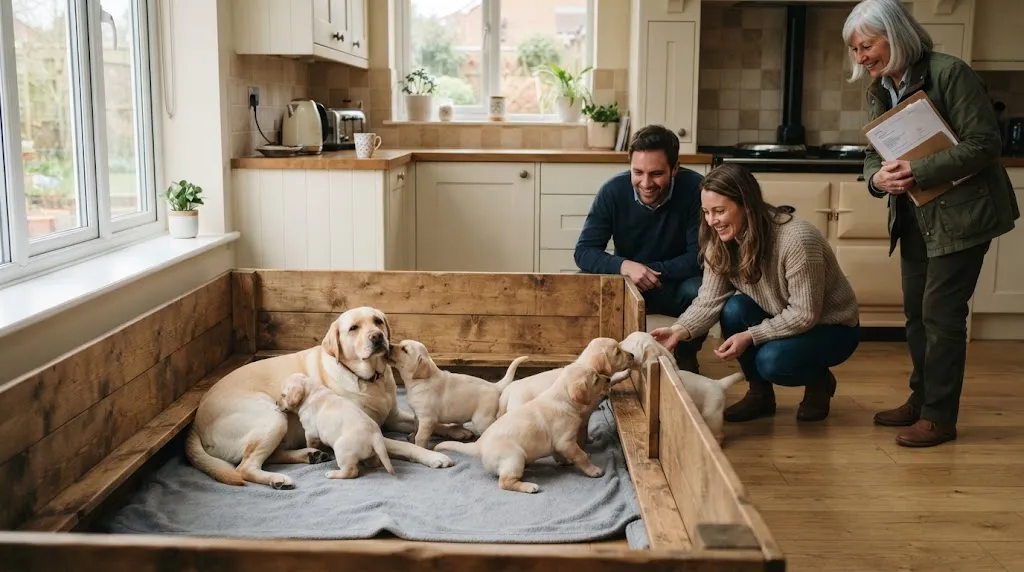
You should see the puppies with their mother, in the home or kennel where they were born, and the breeder should welcome questions and a second visit. The Defra guidance says licensed breeders may only show a puppy to a buyer together with its biological mother, and puppies must be seen interacting with her.
When you arrive, pay attention to more than the puppies. Dogs Trust advises buyers to check that the area is clean, warm, dry and quiet, and that the house feels like a home rather than a property rented to show puppies.
- The mother: she should be relaxed, look well cared for and clearly interact with the puppies.
- The puppies: clear eyes and noses, clean ears and bottoms, no limping and a curious, confident attitude.
- Socialisation: licensed breeders in England must follow a documented socialisation programme from 3 weeks old, so ask to see it.
- The breeder: they should be asking about your home, routine and experience as much as you ask them.
Take a written list of questions so the excitement of meeting puppies does not make you forget the important ones. Our complete checklist of questions to ask a dog breeder in the UK covers every stage, from the first phone call to collection day. It also helps to read up on why early puppy socialisation matters so you know what good answers sound like.
What Paperwork Should a Reputable Breeder Give You?
Expect microchip paperwork, a vet health record, the parents’ health test results, a written contract and care advice, and ask for all of it before collection day. Paperwork that only appears at the last minute, or never appears at all, is a common sign of a dealer.
- Microchip records: every puppy must be microchipped and registered to the breeder as first keeper before sale, so you then transfer it into your name.
- Vet record: vaccinations, worming and flea treatment given so far.
- Parents’ health results: copies you can match against the Health Test Results Finder.
- Registration details: if sold as a registered pedigree, including any endorsements such as a breeding restriction.
- The Puppy Contract: the free Puppy Contract, developed by the RSPCA and the Animal Welfare Foundation, includes an information pack the breeder completes and a contract you both sign.
- Insurance and care advice: many breeders include a short period of cover. Our guide on whether pet insurance is worth it helps you compare that with a full policy.
Why the Puppy Contract protects you
Your legal rights depend on who you buy from. Citizens Advice explains that you have fewer consumer rights when buying from a private seller, and can usually only claim a refund if the puppy did not match the seller’s description.
That is exactly where the Puppy Contract earns its place. Citizens Advice notes that it is legally binding and records a detailed description of the puppy’s health and history, giving you something concrete to rely on if things go wrong.
What Are the Red Flags of a Bad Breeder or Puppy Scam?
Walk away if a seller will not show you the mother, wants a deposit before you visit, offers to deliver the puppy or meet you halfway, or always has puppies available. These are the patterns behind both puppy farms and outright scams.
Scams are a serious problem. PDSA’s PAW Report found that only 42% of dog owners who bought from a breeder had checked the breeder was licensed, and 15% did not know how to check. That gap is what scammers rely on.
| Red flag | Why it matters |
|---|---|
| Mother is “at the vet”, “out for a walk” or kept in another room | The puppy may have been bought in from a puppy farm or imported. |
| Offer to deliver or meet at a service station | PAAG standards say dogs should not be advertised as deliverable by the seller, and you lose any chance to see where the puppy was raised. |
| Deposit requested before you have visited | The puppy may not exist at all. |
| Several breeds or litters always available | Suggests a dealer or volume breeder rather than a careful hobby or licensed breeder. |
| Puppy comes with a pet passport | Defra warns this may mean the puppy was imported; imported puppies must be at least 15 weeks old from the EU and listed countries, or 7 months from other countries. |
| Puppy offered younger than 8 weeks | Illegal for licensed breeders and a strong sign of a poor seller. |
| Docked tail or cropped ears on a non-exempt breed | Mutilations like these are illegal in England and Wales unless specifically exempted. |
| No microchip, or a foreign microchip | Puppies must be chipped and registered to the breeder before sale. |
| Puppy advertised as an XL Bully type | It has been illegal to sell, give away or breed from an XL Bully in England and Wales since the ban came into force. |
Pay attention to how you are asked to pay, too. A bank transfer to a stranger gives you very little protection. Never pay for a puppy you have only seen in photos or on a video call, and always get a written receipt for any deposit.
What should you do if you think you have found a scam or puppy farm?
Report welfare concerns or suspected illegal imports to Trading Standards, as Defra advises. Dogs Trust recommends the RSPCA for welfare concerns in England and Wales, the Scottish SPCA in Scotland, and the local council or the USPCA in Northern Ireland.
If you have lost money in England, Wales or Northern Ireland, report it to Report Fraud, the City of London Police service that has replaced Action Fraud. In Scotland, contact Police Scotland on 101. You can also report a suspicious advert to PAAG.
How Long Does It Take to Find a Reputable Breeder?
Expect weeks to months, because responsible breeders plan litters carefully and usually have waiting lists. Defra’s own guidance tells buyers to expect that they may need to join a waiting list, as buying a healthy animal bred in good welfare conditions can take time.
- Research the breed: make sure its size, energy and grooming needs fit your life, and budget properly with our guide to how much a dog costs per year.
- Build a shortlist: use breed clubs, Find a Breeder and personal recommendations.
- Make first contact: phone, ask about planned litters and expect to answer questions about yourself.
- Verify: check the licence and star rating where relevant, and look up both parents’ health results.
- Join a waiting list: agree in writing how any deposit works and when it is refundable.
- Visit: see the puppies with their mother, ideally more than once.
- Collect: from the breeder’s home, with the Puppy Contract completed, and book a vet check. Dogs Trust recommends a check-up within 48 hours of collection.
Once your puppy is booked, our new puppy checklist will help you get your home ready.
Common Myths About Finding a Good Dog Breeder
Several popular beliefs give buyers false confidence, and most of them come from out-of-date advice still circulating online. Living with a rescued Samoyed has shown me how much a dog’s first weeks shape everything after them, which is why these myths are worth clearing up.
Myth: “Kennel Club registered” means a well-bred puppy. Registration records parentage. The Royal Kennel Club’s own Find a Breeder disclaimer says registration alone is not confirmation that its health and welfare standards have been met.
Myth: Look for a Kennel Club Assured Breeder. The scheme has closed. Any article still recommending it as your main check has not kept up.
Myth: A licensed breeder is always a good breeder. A licence shows that minimum standards were met at inspection. The star rating, health testing and how the puppies are raised tell you far more.
Myth: A video call is as good as a visit. Video can work for an early chat, but it cannot show you how the mother behaves with strangers or whether the puppies actually live there. Always visit in person before paying in full.
Myth: Buying a sad-looking puppy “rescues” it. It funds the next litter. Walk away and report the seller instead.
Should You Consider Adopting Before You Buy?
It is worth checking UK rescues first, because many have puppies, young dogs and even specific breeds looking for homes. Defra suggests considering a rescue animal from a reputable UK rehoming organisation, such as a member of the Association of Dogs and Cats Homes.
The Royal Kennel Club also runs a breed rescue finder, which is a good route if your heart is set on a particular breed. Our step-by-step guide on how to adopt a dog in the UK explains the process, and our independent guides to charities such as Dogs Trust and Battersea show what each one offers.
Recommended viewing: search YouTube for a puppy-buying advice video from Dogs Trust, the RSPCA or the Royal Kennel Club that shows what a breeder visit should look like. [YOUTUBE: add a verified video URL here on its own line]
FAQs
How do I know if a dog breeder is legit in the UK?
A legitimate breeder will show you the puppy with its mother at their home, give you both parents’ health test results to verify, provide microchip and vet records, and use a written contract such as the Puppy Contract. If they breed three or more litters a year or run a business, they should also hold a council licence you can check.
Is the Kennel Club Assured Breeders scheme still running?
No. The Kennel Club closed its Assured Breeders scheme. The Royal Kennel Club runs a separate Find a Breeder directory listing breeders who meet its Good Practice health standard where one applies, but it states that a listing is not an endorsement or guarantee, so you still need to carry out your own checks.
Can I check a dog breeder’s licence online?
Often, yes. Ask the breeder for their licence number and issuing council, then search that council’s public register of animal activity licences. Many registers show the star rating and expiry date. If your council does not publish one online, contact its licensing or environmental health team to confirm the details.
Do all dog breeders in the UK need a licence?
No. In England, a licence is needed for breeding three or more litters in 12 months and selling puppies, or for breeding and advertising a business of selling dogs. Scotland, Wales and Northern Ireland use slightly different thresholds. A small hobby breeder with one litter may legally have no licence, so judge them on their health testing and paperwork.
Should I pay a deposit to a dog breeder?
Many reputable breeders take a deposit to hold a puppy, but only pay after you have visited and seen the puppy with its mother. Agree in writing when the deposit is refundable, get a receipt, and avoid paying by bank transfer to someone you have never met. Never pay for a puppy seen only in photos.
How long is the waiting list for a good dog breeder?
It varies by breed and breeder, but waiting several weeks or months is normal. Responsible breeders plan each litter and limit how often a mother is bred, so they rarely have puppies available immediately. A seller who always has puppies ready to go is more likely to be a dealer or high-volume breeder.
Related Articles
- Questions to Ask a Dog Breeder in the UK: The Complete Checklist
- How to Adopt a Dog in the UK: Your Complete Step-by-Step Guide
- Your New Puppy Checklist: Everything You Need to Know
- RSPCA Adoption Requirements UK Explained
- Independent Guides to UK Rescue Charities
Conclusion
Finding a reputable dog breeder in the UK comes down to evidence. Start with breed clubs and the Royal Kennel Club Find a Breeder directory, then check the licence and star rating where one applies, verify both parents’ health results yourself and only buy with the Puppy Contract in place.
A good breeder will welcome every check, ask you plenty of questions and make you wait for the right litter. If any part of the process feels rushed, vague or too good to be true, walk away and report it.
And before you commit, take a look at the dogs waiting in UK rescue centres. Browse our guides to UK rescue charities to find a centre near you; the right dog for your family may already be there.
Disclaimer: This article is for general information only and does not replace legal or veterinary advice. Licensing rules differ across the UK and can change, so check with the relevant local council, and ask your vet which health tests are relevant to your chosen breed.