

Many fish arrive in UK homes the hard way. Some are funfair prizes, some are rehomed by owners who could not cope, and some come from rescue centres. Whatever their story, every fish depends on one thing above all else: clean, stable water.
Knowing how to clean a fish tank properly is the single most important skill a fishkeeper can learn. Clean too little and toxic waste builds up. Clean too hard, or with the wrong water, and you can wipe out the bacteria that keep your fish alive.
This guide walks you through a safe weekly routine, explains what UK tap water means for your fish, and reviews the best fish tank glass cleaners and aquarium scrapers to make the job quicker.
Affiliate disclosure: Some links in this article may be affiliate links. If you buy through them, PetRescueBlog may earn a small commission at no extra cost to you. This never affects our recommendations.
Quick Answer
To clean a fish tank, leave your fish in place, switch off the heater and filter, wipe the glass, then vacuum the gravel while siphoning out 25 to 30% of the water. Rinse filter media in the old tank water, never under the tap. Refill with dechlorinated water at the same temperature, then switch everything back on.
| Category | Recommendation |
|---|---|
| Best Overall Glass Cleaner | JBL Floaty II, a floating magnet that protects silicone seals, from around £15.66 to £52.03 depending on size. |
| Best Budget | Tetra Magnetic Cleaner, a floating glass-only magnet, from around £7.39 to £13.00. |
| Best Aquarium Scraper | D-D Aquascraper 4-in-1, a long-handled scraper with steel and plastic blades, from around £8.66 to £16.99. |
| Best Premium | Flipper Float, a magnet that flips from scrubber to scraper blade, from around £43.64 to £44.99. |
Key Takeaways
- Most freshwater tanks need a partial water change of around 25 to 30% every week, with the gravel vacuumed at the same time.
- Never remove all the water or wash filter media under the tap, because both destroy the beneficial bacteria that break down fish waste.
- Many UK water companies use chloramine, which does not evaporate, so always use a dechlorinator that is labelled to remove chloramine.
- Ammonia and nitrite should always read zero, and clear water is not proof that water is safe.
- A magnetic algae cleaner or long-handled aquarium scraper cleans the glass without putting your hands in the water.
- Wear waterproof gloves and wash your hands and forearms afterwards, as aquarium water can carry bacteria that infect cuts.
- Pour old tank water on your garden or lawn, away from drains and watercourses, to stop invasive plant fragments spreading.
How Often Should You Clean a Fish Tank?
The RSPCA recommends weekly 30% water changes to dilute the waste your filter cannot break down. Practical Fishkeeping describes 25% weekly as the norm for a typically stocked tank, with 50% changes kept for emergencies.
The right amount depends on your fish. Fishkeeper notes that messy fish such as goldfish do best with large, frequent changes. More delicate setups prefer smaller changes of around 10%.
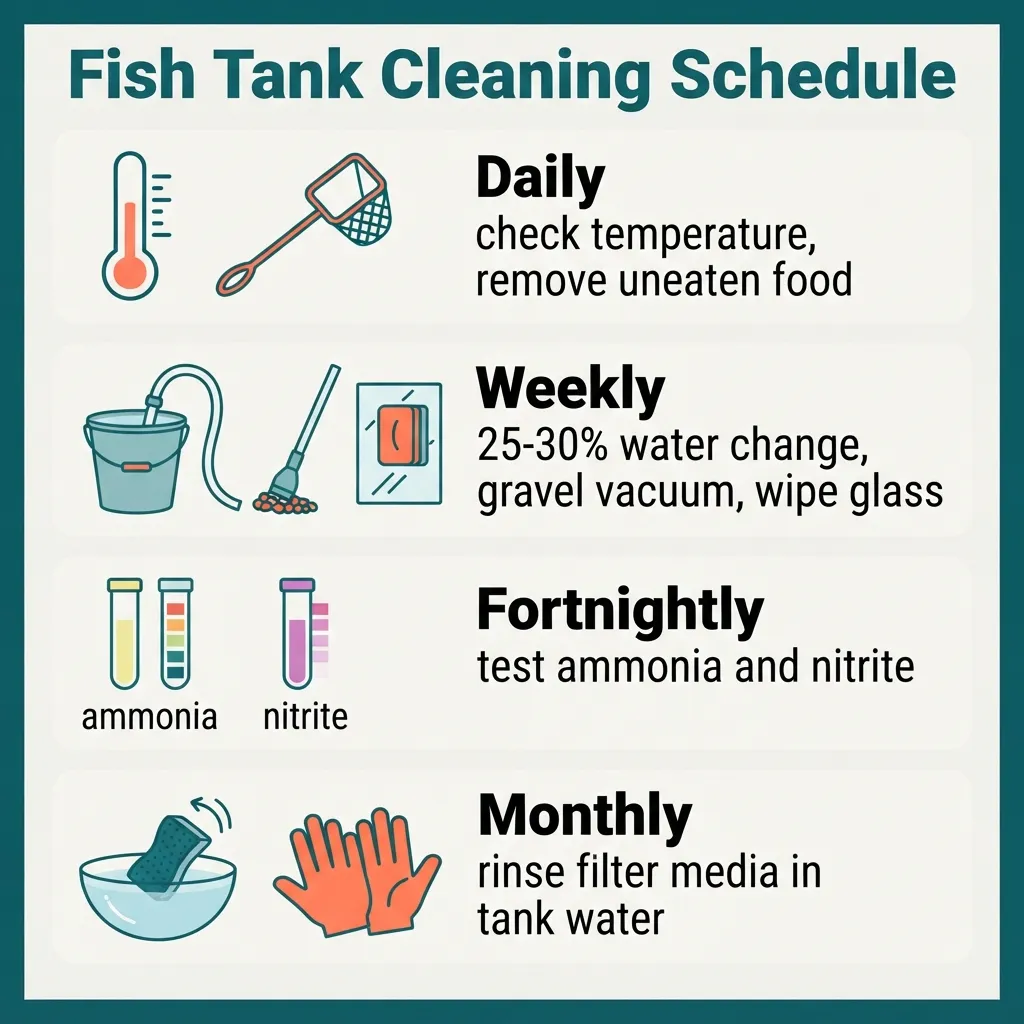
| How often | Task |
|---|---|
| Daily | Check the temperature with a digital thermometer, remove uneaten food and watch your fish for unusual behaviour. |
| Weekly | Change 25 to 30% of the water, vacuum the gravel and wipe algae from the glass. |
| Fortnightly (at least) | Test for ammonia and nitrite, plus nitrate and pH if your kit allows. |
| Monthly | Rinse filter media in old tank water and check the filter impeller. |
| As needed | Clean decorations, remove limescale and trim plants. |
Signs your tank needs cleaning sooner
- Cloudy or smelly water: often a sign of excess waste or overfeeding.
- Fish gasping at the surface: can indicate poor water quality or low oxygen. Test the water straight away.
- Rapid algae growth: usually linked to high nitrate, too much light or overfeeding.
- Ammonia or nitrite above zero: the RSPCA advises changing half the water daily and retesting until levels improve.
What You Need to Clean a Fish Tank
You do not need much kit, but each item should be used only for your aquarium. Household cleaning products must never touch it.
| Item | What it does | Approximate UK price |
|---|---|---|
| Gravel cleaner (siphon) | Removes waste from the gravel while draining water | £6 - £20 (Fluval Easy Clean from £9.25) |
| Dedicated bucket | Collects old water and holds filter media for rinsing | £3 - £8 |
| Dechlorinator (chloramine-safe) | Makes tap water safe for fish and filter bacteria | Around £11 - £12 for Seachem Prime 250ml |
| Liquid test kit | Measures ammonia, nitrite, nitrate and pH | Around £28 - £50 for the API Freshwater Master Test Kit |
| Glass cleaner or algae scraper | Removes algae and film from the glass | £7 - £45 (see our picks below) |
| Digital thermometer | Lets you match new water to tank temperature | £3 - £10 |
| Waterproof gloves | Protect cuts and grazes from aquarium bacteria | £3 - £10 |
Prices are approximate and vary by retailer and size.
How to Clean a Fish Tank Step by Step
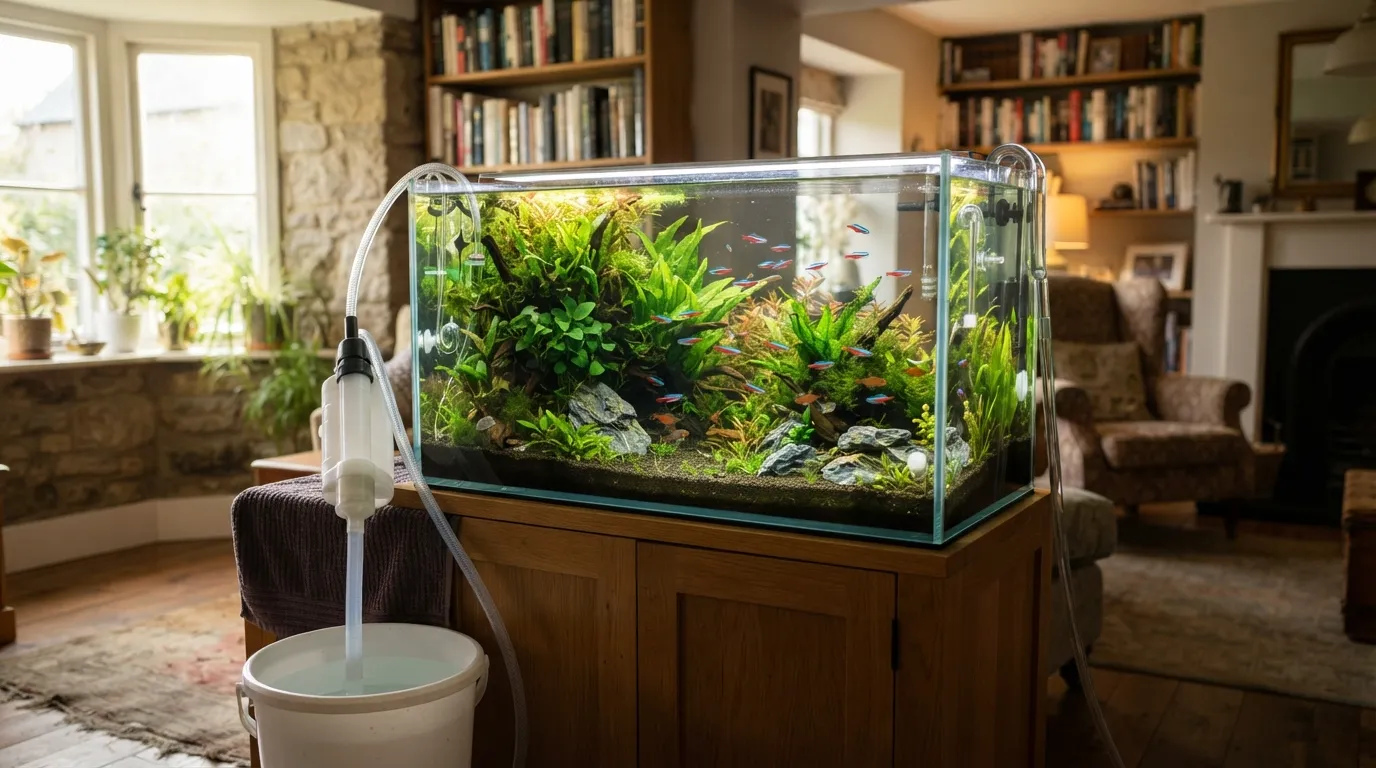
This routine suits most freshwater tanks, both tropical and coldwater. Leave your fish in the tank throughout, as netting them out causes unnecessary stress. Allow around 30 to 60 minutes.
Step 1: Prepare and protect yourself
Wash your hands, then put on waterproof gloves if you have any cuts or grazes. Switch off and unplug the heater and filter before the water level drops. A heater left running out of water can crack.
Step 2: Clean the glass first
Wipe the inside glass with a magnetic algae cleaner or aquarium scraper before removing any water. Doing the glass first means any loosened algae is siphoned out with the water change.
Step 3: Vacuum the gravel and remove water
Push the gravel cleaner into the substrate and let the siphon lift out waste. Practical Fishkeeping recommends combining gravel cleaning with your partial water change. Stop once you have removed 25 to 30% of the water.
Step 4: Rinse decorations in old tank water
Lift out ornaments or artificial plants that look grubby and scrub them gently in the bucket of removed water. Never use soap, detergent or bleach on anything that goes back in an occupied tank.
Step 5: Rinse the filter media (monthly)
Squeeze sponges and rinse media in the removed tank water until the worst of the dirt is gone. The RSPCA warns that washing media under the tap kills the beneficial bacteria. Fishkeeper’s rule is simple: keep your water clean and your filter dirty.
While the filter is open, check the impeller. Practical Fishkeeping advises removing it, cleaning the impeller well with a cotton bud and making sure it spins freely before reassembly. For more on filters, see our guide to choosing the right aquarium filter.
Step 6: Prepare the replacement water
Fill a clean bucket with tap water and add a dechlorinator that removes both chlorine and chloramine. Match the temperature to your tank using a thermometer. The RSPCA warns that a temperature difference can shock fish.
Step 7: Refill slowly
Pour the new water gently onto a decoration or your hand so it does not blast the gravel or your fish. Top up to the original level.
Step 8: Restart equipment and check
Plug the filter back in first, then the heater once it is fully submerged. Check the temperature again after an hour.
Step 9: Test, record and dispose responsibly
Test the water and note the results so you can spot trends. Wash your hands and forearms with soap and running water. Pour the old water on your lawn or garden plants, as explained in our disposal section below.
How Do I Clean a Tropical Fish Tank?
Cleaning a tropical fish tank follows the same steps, with extra care over temperature. Tropical fish need a heater set to suit their species. The RSPCA gives examples such as guppies at 22 to 28°C and loaches at 18 to 26°C.
- Switch the heater off first: and only switch it back on once it is fully underwater again.
- Warm the new water: the RSPCA suggests a separate heater for pre-warming replacement water, which helps in colder UK homes.
- Change smaller amounts more often: if your room is cold, smaller changes reduce temperature swings.
Goldfish and other coldwater fish are kept at 10 to 21°C and rarely need a heater, but they produce more waste. See our goldfish care guide for tank sizes and stocking.
UK Tap Water: Chlorine, Chloramine and Your Fish
This is the part most cleaning guides miss. UK tap water is safe to drink but harmful to fish and filter bacteria until it has been treated.
According to Practical Fishkeeping, water companies including Thames, Welsh Water, Scottish Water and parts of Anglian Water have switched from chlorine to chloramine. Scottish Water says more than 1.75 million of its customers receive chloraminated water.
Chloramine matters because it behaves differently from chlorine. Practical Fishkeeping explains that boiling, standing or aerating water will not remove it. Many basic conditioners also leave behind ammonia when they break chloramine down.
- Do not rely on leaving water to stand: this old advice only works for chlorine, not chloramine.
- Choose a chloramine-safe conditioner: check the label says it removes chloramine and detoxifies ammonia.
- Check your water report: OATA notes that most water companies offer an online postcode checker showing your local water quality.
- Test your tap water too: nitrate levels in UK tap water vary by area, so a high tank reading may start at the tap.
The Drinking Water Quality Regulator for Scotland confirms that fishkeepers must treat any tap water and should know how their supply is disinfected.
Safe water readings
| Parameter | Target | Source |
|---|---|---|
| Ammonia | 0mg/l (free ammonia never above 0.02mg/l) | OATA water quality criteria |
| Nitrite | 0mg/l (never above 0.2mg/l) | OATA water quality criteria |
| Nitrate | Under 50mg/l, with action needed above 100mg/l | Practical Fishkeeping |
The RSPCA describes ammonia and nitrite test kits as essential rather than optional. Clear water does not always mean healthy water.
How to Clean Algae From a Fish Tank
Some algae is normal in a healthy aquarium. The goal is to keep it off the front glass and stop it taking over.
- Soft green film: wipes away easily with a magnetic algae cleaner or pad.
- Green spot algae: hard and stubborn, so it needs a scraper blade on glass or a plastic blade on acrylic.
- White limescale at the waterline: common in hard water areas of the UK. Lower the water level and scrape it with a blade. Some keepers use a little white vinegar on kitchen roll above the waterline, as members of the UK Aquatic Plant Society forum describe, but keep vinegar out of the water itself.
Scraping removes algae but does not fix the cause. Reduce lighting to around 8 to 10 hours a day, which the RSPCA says suits most species. Feed less, keep up with water changes and keep the tank away from sunny windows.
Best Fish Tank Glass Cleaners and Aquarium Scrapers
A good fish tank glass cleaner turns algae removal into a two-minute job. There are two main types. Algae magnets clean from outside the tank, while handheld aquarium scrapers use a blade for stubborn algae and corners.
What to Look For
- Glass or acrylic: metal blades scratch acrylic, so acrylic tanks need plastic blades or soft pads only.
- Glass thickness: magnets are sized by glass thickness. Too weak and they slip, too strong and they are hard to move.
- Floating inner part: if the magnets separate, a floating inner half rises to the surface instead of sinking into the gravel.
- Blade or pad: pads handle soft film. Blades remove hard spot algae and limescale.
- Handle length: long-handled scrapers reach corners and the bottom of deep tanks without wet arms.
- Tank shape: curved or bow-front tanks suit small, flexible cleaners better than large flat magnets.
1. JBL Floaty II
The JBL Floaty II is a well-made floating algae magnet from an established German aquatics brand. Its inner element floats, and bevelled edges are designed to protect the silicone seals at the corners.
Best For: Everyday glass cleaning on standard rectangular tanks.
- Floating internal element for easy retrieval
- Protruding cleaning edge reaches behind equipment and into corners
- Available in several sizes for different glass thicknesses
- Pro: Gentle on silicone seals
- Pro: Hands stay dry throughout
- Con: JBL states it cannot work effectively on curved panes
- Con: Sand trapped under the pad can still scratch glass, as with any magnet
Price Range: £15.66 – £52.03 (prices vary by retailer and size)
2. Tetra Magnetic Cleaner
The Tetra Magnetic Cleaner is a simple, affordable floating algae magnet for glass tanks. Its floating inner half reduces the chance of picking up gravel and scratching the glass.
Best For: Beginners and owners on a tight budget.
- Floating internal element
- Medium size for 5mm glass, large size for 10mm glass
- Suitable for freshwater and marine tanks
- Pro: Very low cost
- Pro: Widely available from UK retailers
- Con: For glass aquariums only
- Con: Soft pad struggles with hard spot algae
Price Range: £7.39 – £13.00 (prices vary by retailer and size)
3. D-D Aquascraper 4-in-1
The D-D Aquascraper is a long-handled aquarium scraper with interchangeable heads. It includes a stainless steel blade for glass, a plastic blade for acrylic, a rotating polisher and a gravel shovel.
Best For: Stubborn algae, deep tanks and acrylic aquariums.
- Handle lengths of 6, 12, 24 and 36 inches
- Angled 3-inch blades for leverage
- Steel blade for glass, plastic blade for acrylic
- Pro: Removes algae that magnets cannot shift
- Pro: Replacement blades are inexpensive
- Con: Your hand is closer to the water than with a magnet
- Con: Steel blades must never be used on acrylic
Price Range: £8.66 – £16.99 (prices vary by retailer and handle length, per Complete Aquatics and Kraken Corals)
4. Flipper Float
The Flipper Float combines an algae magnet and a scraper in one. Rotate the handle and the inner half flips from a scrubbing pad to a blade. Practical Fishkeeping’s review praised its ability to tackle stubborn algae without a wet hand.
Best For: Larger tanks and owners wanting one tool.
- Flips between scrubber and blade without removing it
- Floats to the surface if the magnets separate
- Blade side sits on three contact points to reduce trapped sand
- Pro: Handles both soft film and hard algae
- Pro: Smaller Nano and Pico versions suit smaller tanks
- Con: Much more expensive than a basic magnet
- Con: Strong rare earth magnets can pinch fingers
Price Range: £19.99 – £44.99 (Pico to standard Float; prices vary by retailer and size)
5. Mag-Float Floating Algae Magnet (Small)
The Mag-Float Small is a lightweight floating magnet for small glass aquariums. It is a sensible pick for nano tanks, betta setups and starter kits.
Best For: Small and nano glass tanks.
- Floating inner half
- Compact, lightweight design
- Non-abrasive cleaning surface
- Pro: Easy to handle in tight spaces
- Pro: Affordable
- Con: Too small for large tanks or thick glass
- Con: No blade for hard algae
Price Range: Around £9.99 (prices vary by retailer)
Also worth considering: the Fluval Razor+ 2-in-1 Algae Magnet combines a scrubber with a stainless steel blade. UK replacement blades are widely sold, but we could not verify consistent UK pricing for the magnet itself, so it is not ranked here.
Comparison Table
| Product | Best For | Key Feature | Price Range |
|---|---|---|---|
| JBL Floaty II | Everyday glass cleaning | Floating magnet that protects silicone seals | £15.66 - £52.03 |
| Tetra Magnetic Cleaner | Beginners on a budget | Floating inner half, glass only | £7.39 - £13.00 |
| D-D Aquascraper 4-in-1 | Stubborn algae and acrylic tanks | Long handle with steel and plastic blades | £8.66 - £16.99 |
| Flipper Float | Larger tanks, one-tool cleaning | Flips from scrubber to blade | £19.99 - £44.99 |
| Mag-Float Small | Nano and small tanks | Compact floating magnet | Around £9.99 |
Buying Guide: Choosing an Aquarium Glass Cleaner
Magnet or scraper?
Most owners benefit from both. Use an algae magnet for the weekly wipe and an aquarium glass scraper for stubborn spots, corners and limescale. If you only want one tool, a flip-style magnet such as the Flipper covers both jobs.
Protecting your glass
Scratches almost always come from sand or gravel trapped under the pad. Keep magnets away from the substrate line, and rinse the pad if it touches the bottom. JBL notes that its magnet materials are softer than aquarium glass, so trapped grit is the real culprit.
Acrylic tanks need extra care
Acrylic scratches far more easily than glass. Use only cleaners labelled safe for acrylic, and swap metal blades for plastic ones.
Match the size to your tank
Check your glass thickness before buying a magnet. Small tanks suit compact cleaners, while deep tanks benefit from longer scraper handles.
Best Algae Eaters for Small Tanks
Algae eaters can help keep a tank tidy, but they are a support act, not a replacement for cleaning. Choose species that stay small and suit your water temperature.
| Algae eater | Good at | Things to know |
|---|---|---|
| Nerite snails | Green film and spot algae on glass and rocks | Cannot breed in freshwater, so they will not overrun a tank. They do lay small white eggs. |
| Amano shrimp | Hair algae and soft algae | Hard-working grazers. Best kept in a small group. |
| Cherry shrimp | Biofilm and soft algae | Hardy and colourful, and suit nano tanks. |
| Otocinclus catfish | Soft film on glass and leaves | Need a group and a mature tank with plenty of algae. |
Practical Fishkeeping rates Amano shrimp highly for their sheer work rate on most algae types. It also notes that bristlenose catfish reach about 12.5cm, so they are not suited to small tanks. UK keepers on the ThinkFish forum often recommend nerite snails as the best option for small tanks, with otocinclus needing a group of at least six.
Feeding algae eaters
In a clean tank, algae eaters can run out of food. Supplement with sinking algae wafers. Hikari’s feeding guidance is to give only what your fish finish within two hours and remove leftovers. Many bottom feeders are active at night, so feed just before lights out.
Common Fish Tank Cleaning Mistakes
- Changing all the water: this resets the beneficial bacteria and can cause an ammonia spike.
- A big rescue clean after months of neglect: a sudden large change can shift pH, making existing ammonia far more toxic. Make several smaller changes over a few days instead.
- Washing filter media under the tap: chlorine and chloramine kill filter bacteria.
- Using soap or household cleaners: even tiny residues can harm fish.
- Skipping the dechlorinator: standing water does not remove chloramine.
- Replacing all filter media at once: if media must be replaced, swap only part of it at a time.
- Overcleaning a new tank: new tanks need time to build bacteria. Read our guide to fishless cycling before adding fish.
Staying Safe and Disposing of Waste Water
Protect your skin
Aquarium water can carry Mycobacterium marinum, which causes a skin infection known as fish tank granuloma. MedlinePlus explains that it enters through cuts or scrapes, with signs usually appearing two to three weeks after exposure. Wear rubber gloves when cleaning, and wash your hands and forearms afterwards. See your GP if a slow-healing lump appears on your hand or arm.
Dispose of dirty water responsibly
OATA advises using aquarium wastewater on your lawn or garden plants, away from ponds, rivers and drains that flow into them. This stops fragments of invasive plants reaching the wild. Never release fish or plants into the wild.
Your legal duty of care
Pet fish are protected by the Animal Welfare Act 2006. The RSPCA explains that Section 9 requires owners to take reasonable steps to meet their animals’ welfare needs, including a suitable environment. For fish, regular cleaning and safe water are a core part of that duty.
FAQs
How often should you clean a fish tank?
Most freshwater tanks need a partial water change of around 25 to 30% once a week, with the gravel vacuumed at the same time. Rinse the filter media in old tank water roughly once a month, test for ammonia and nitrite at least every fortnight, and check the temperature daily. Heavily stocked tanks and messy fish such as goldfish may need more frequent changes.
How do I clean a tropical fish tank?
Switch off and unplug the heater and filter, clean the glass, then siphon out about a quarter of the water while vacuuming the gravel. Rinse filter media in the removed tank water, never under the tap. Refill with dechlorinated water that matches the tank temperature, as tropical fish are stressed by sudden changes. Switch the heater back on once it is fully submerged.
Can you clean algae off aquarium glass without removing the fish?
Yes. A magnetic algae cleaner or a long-handled aquarium scraper lets you clean the glass while your fish stay in the tank. Clean the glass before your water change so loosened algae is siphoned out. Use plastic blades on acrylic tanks and keep sand away from the cleaning pad to avoid scratches.
Do shrimp clean algae?
Many do. Amano shrimp are among the hardest-working algae eaters for freshwater tanks and graze soft and hair algae. Cherry shrimp also pick at algae and biofilm. Shrimp help keep algae down but will not fix the cause, such as too much light, overfeeding or infrequent water changes.
Do fish eat algae in an aquarium?
Some do. Otocinclus catfish, bristlenose catfish and mollies are well-known grazers, and livebearers such as guppies and platies also nibble algae. Most fish will not clear an algae problem on their own, so regular water changes and sensible lighting remain essential.
Do endlers eat algae?
Endlers will graze on some soft algae, much like their close relatives the guppies, but they are not dedicated algae eaters. Think of them as a small bonus rather than a clean-up crew. Nerite snails or Amano shrimp do far more work in a small tank.
Do algae eaters eat fish poop?
No. Algae eaters graze on algae, biofilm and leftover food, but they do not remove fish waste. Larger algae eaters such as plecos actually add to the waste in your tank. The only reliable way to remove fish poop is to vacuum the gravel during regular water changes.
Can an algae eater live with goldfish?
It is usually best avoided. Goldfish are coldwater fish, while most algae eaters are tropical. The Chinese algae eater is a poor choice because it can latch on to other fish and feed on their protective slime coat. Regular water changes and a magnetic glass cleaner are the safer answer to algae in a goldfish tank.
How long should I leave an algae wafer in the tank?
Feed only what your fish will finish within about two hours, then remove anything left over. Many algae eaters feed at night, so dropping the wafer in just before lights out often works best. Uneaten wafers break down and pollute the water.
How often should I feed algae wafers?
It depends on how much natural algae is in your tank. Many keepers offer algae wafers two or three times a week as a supplement, increasing the amount for plecos in tanks with little algae. If wafers are regularly left uneaten, cut back.
Conclusion
Cleaning a fish tank is less about scrubbing and more about consistency. A weekly 25 to 30% water change, a gravel vacuum, chloramine-safe conditioner and a monthly filter rinse in old tank water will keep most aquariums healthy.
For the glass, the JBL Floaty II is our top all-round pick, the Tetra Magnetic Cleaner suits tight budgets, and the D-D Aquascraper handles stubborn algae that magnets leave behind.
Fish are often overlooked when people think about rescue animals, yet many need new homes. If you are thinking of adding fish, consider asking a UK rescue centre or reputable aquatics retailer about fish that need rehoming, and give them the clean, stable home they deserve.
Disclaimer: This article is for informational purposes only and does not replace professional veterinary advice. If your fish show signs of illness, contact a vet with fish experience or a qualified aquatics specialist. Always consult your GP about any skin infection.