


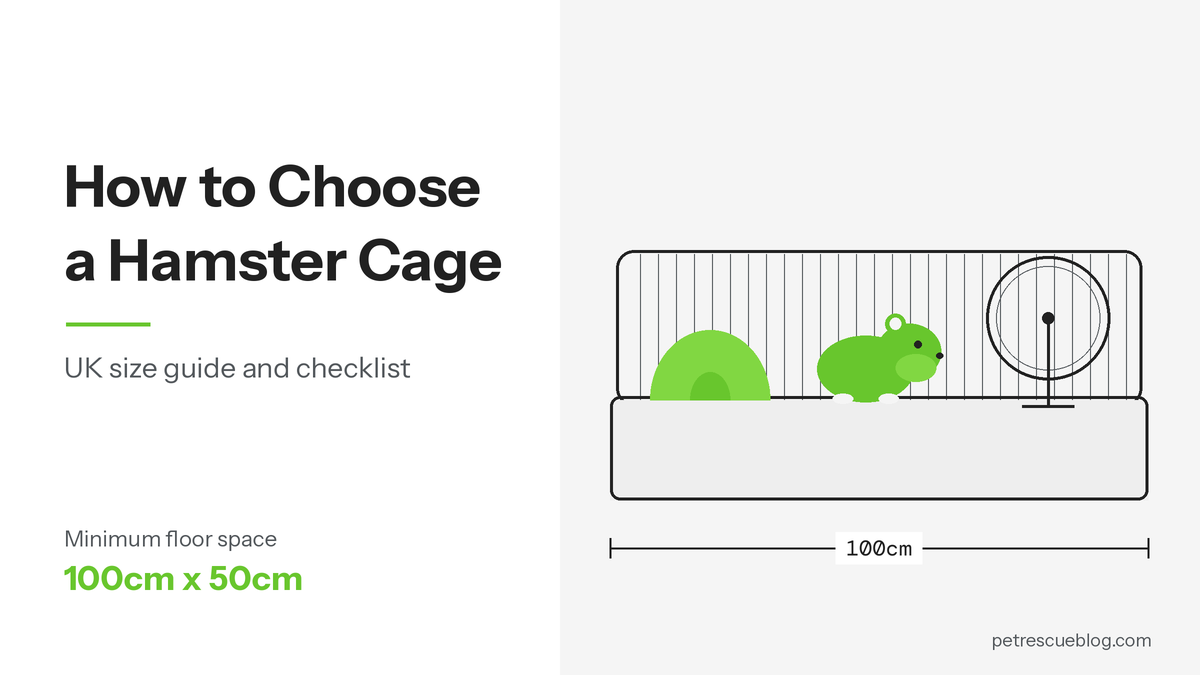
Knowing how to choose a hamster cage is the most important decision you will make for a new hamster, because the cage is where it spends almost its whole life. Many hamsters that arrive at UK rescue centres come from homes where the cage was far too small, often because the owner was given poor advice at the point of sale.
The good news is that the rules are simple once you know them. UK charities agree on a clear minimum floor size, and a handful of extra checks (height, bar spacing, wheel size and bedding depth) separate a good cage from a bad one.
This guide gives you the exact measurements, a checklist to take shopping, the pros and cons of each cage type, and typical UK prices.
Key Takeaways
- A hamster cage should be at least 100cm long and 50cm wide, measured as unbroken floor space, for every hamster species.
- Syrian hamster cages should be at least 50cm tall; dwarf hamster cages at least 40cm tall.
- Bar spacing should be no wider than 1cm for Syrian hamsters and about 7mm for dwarf and Roborovski hamsters.
- The cage must hold deep bedding, ideally around 25cm in at least part of the enclosure, so the hamster can burrow.
- Choose one large, low cage over a tall cage with several small levels and tubes.
- Keep one hamster per cage, indoors, in a quiet spot at a steady 18 to 21°C.
- Cages that meet the 100cm minimum typically cost around £85 to £240 in the UK.
Quick Answer
To choose a hamster cage, buy the largest cage you can fit, with at least 100cm x 50cm of unbroken floor space, a deep base for bedding, narrow bar spacing and room for a large solid wheel. The table below shows the minimums by species.
| Hamster species | Minimum floor size | Minimum height | Bar spacing | Wheel size |
|---|---|---|---|---|
| Syrian (golden) and Chinese | 100cm x 50cm | 50cm | 1cm or less | At least 30cm (12 inches) |
| Dwarf (Campbell’s, Winter White, hybrids) | 100cm x 50cm | 40cm | About 7mm | At least 20cm (8 inches) |
| Roborovski | 100cm x 50cm | 40cm | About 7mm | At least 20cm (8 inches) |
Sources: Woodgreen Pets Charity hamster care guide and PDSA advice on the ideal home for your hamster.
What Length Should a Hamster Cage Be?
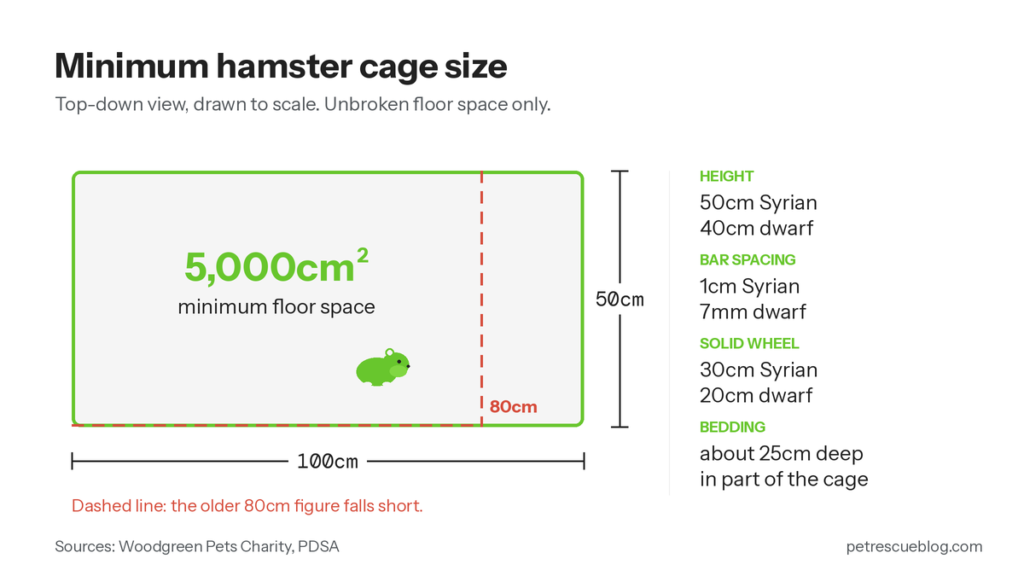
A hamster cage should be at least 100cm long and 50cm wide, according to Woodgreen Pets Charity, which says all species of hamster should live in an enclosure of at least that size. That gives 5,000cm² of floor space. Longer is better, and 100cm is a minimum, not a target.
The length must be unbroken floor space. Shelves, platforms, tubes and upper levels do not count towards it. A cage sold as “100cm” with a 70cm base and a few shelves does not meet the minimum.
The same 100cm length applies to dwarf hamsters, even though they are smaller. Dwarf and Roborovski hamsters are fast, very active runners, and UK charities give them the same floor size as Syrians.
Why UK Charities Settled on 100cm x 50cm
UK charities settled on 100cm x 50cm because it matches the guideline from the Veterinary Association for Animal Welfare (TVT), a German veterinary body. The PDSA notes there is not much evidence on exact cage sizes, but cites this 100x50cm minimum and adds that bigger is always better.
Older advice quoted smaller figures, such as 80cm x 50cm for Syrians and 70cm x 40cm for dwarf hamsters. UK vet Laura Waring MRCVS explains in a Vet Help Direct article on hamster space that the PDSA and Blue Cross have adopted the 100 x 50cm guideline, and her practice recommends “at least 100 x 50 x 50cm for all species of hamster”.
The RSPCA does not publish a fixed size. Its hamster environment guidance focuses instead on a cage large enough for a thick layer of bedding and nesting material. If you follow the 100cm minimum, you meet every UK charity’s advice at once.
How Tall Should a Hamster Cage Be?
A hamster cage should be at least 50cm tall for Syrian and Chinese hamsters and at least 40cm tall for dwarf and Roborovski hamsters, according to Woodgreen’s minimum enclosure sizes. Height matters mainly because it lets you add deep bedding while leaving room for a large wheel.
Height does not replace floor space. The PDSA recommends single-level cages over tall, multi-level ones, because hamsters have poor eyesight and can be hurt in falls.
Hamster Cage Checklist: 7 Things to Check Before You Buy
This hamster cage checklist covers the seven measurements and features UK charities and vets recommend. Take it with you when you shop, or use it to check online listings, which often give outer dimensions rather than the usable floor size.
- Unbroken floor space of 100cm x 50cm or more: measure the base, not the shelves. Multiply length by width; you need at least 5,000cm².
- A deep base for bedding: the PDSA recommends bedding no less than 25cm (10 inches) deep. Woodgreen suggests at least 6 inches across most of the enclosure with a deeper 10 to 12 inch digging area.
- Safe bar spacing: 1cm for Syrian and Chinese hamsters and about 7mm for dwarf and Roborovski hamsters, per Woodgreen. Wider bars let small hamsters squeeze out.
- Room for a large solid wheel: at least 30cm for Syrians and 20cm for dwarfs, per the PDSA. Small wheels force a hamster to run with a curved back.
- A solid floor: the RSPCA warns against wire mesh floors, which can cause foot problems.
- One main level: a large, low cage is safer than a tall tower of small floors.
- Secure doors and lid, with easy access: hamsters are escape artists, and a wide top opening makes spot cleaning and handling much easier.
Types of Hamster Cage Compared
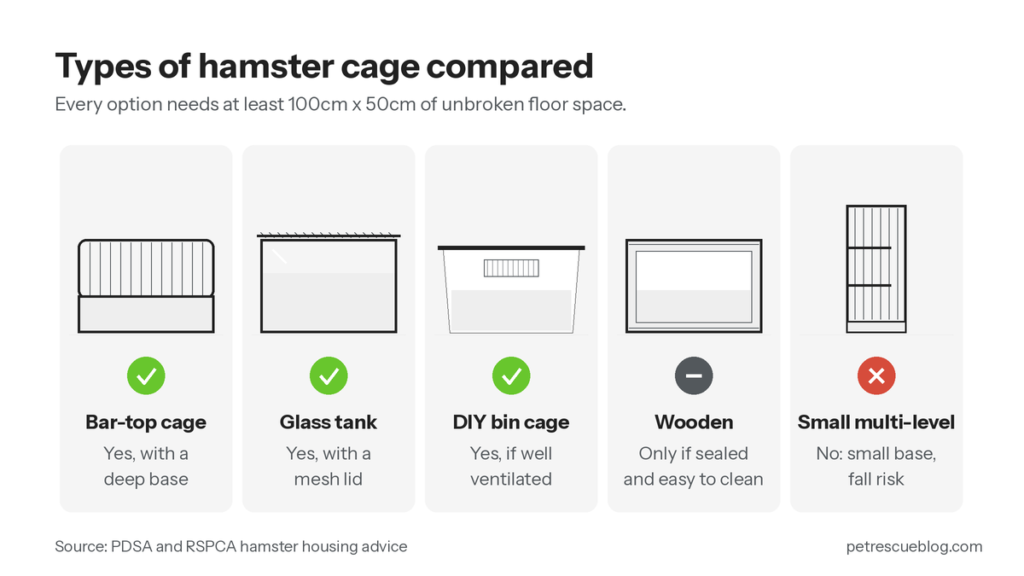
The main types of hamster cage are bar-top cages, glass tanks, wooden enclosures, home-made bin cages and multi-level shop cages. The PDSA lists an extra-large cage, a glass tank or a homemade enclosure as good options, as long as the floor size is right.
| Cage type | Pros | Cons | Good choice? |
|---|---|---|---|
| Large bar-top cage with deep plastic base | Good airflow, light, widely sold in 100cm sizes | Base may be too shallow for 25cm of bedding; check bar spacing | Yes, if 100cm x 50cm with a deep base |
| Glass tank or aquarium | Holds very deep bedding, no bar chewing, quiet | Heavy, needs a ventilated mesh lid, can be expensive at 100cm | Yes, with a secure mesh lid |
| Wooden enclosure | Attractive, often large, holds deep bedding | Wood can absorb urine; the RSPCA advises against wooden cages | Only if sealed and easy to clean |
| Home-made bin cage | Cheap way to reach a large floor size | Needs good ventilation holes covered with mesh; some plastics get chewed | Yes, if well ventilated and large enough |
| Small multi-level cage with tubes | Looks fun, cheap, widely sold | Small base, shallow bedding, fall risk, tubes are hard to clean | No |
Why Small Hamster Cages Cause Problems
Small hamster cages cause problems because they stop hamsters running, digging and foraging, which are their strongest natural behaviours. Woodgreen notes that hamsters travel long distances in the wild, some up to five miles (about 8km) in 24 hours.
A cramped cage leads to stress behaviours. Blue Cross explains that without enough deep bedding to dig into, hamsters get stressed and often begin to climb the bars and chew them. If your hamster chews or climbs its bars at night, a bigger cage and deeper bedding are the first things to check. Our guide to common hamster habits explains other behaviours that worry new owners.
How Much Does a Hamster Cage Cost in the UK?
A hamster cage that meets the 100cm minimum typically costs around £85 to £240 in the UK. Examples on Zooplus UK include a 100 x 56cm bar-top cage at around £95 and 115 x 50cm wooden enclosures at around £236.
| Option | Approximate UK price range |
|---|---|
| 100cm bar-top cage with plastic base | £85 to £130 |
| Large wooden or glass-fronted enclosure (100cm to 120cm) | £150 to £240 |
| Home-made bin cage (storage box, mesh, fixings) | Varies widely with materials |
| Second-hand 100cm cage | Often well below new prices; clean and disinfect before use |
Prices vary by retailer, season and model. Check the internal floor size on any listing before you buy.
A large cage costs more than the small kits sold in many shops, but it is a one-off cost. Buying a small cage first and upgrading later usually costs more overall. Budget for a large solid wheel, hides and plenty of bedding as well; our guide to taking care of a hamster covers the full set-up.
Where Should You Put a Hamster Cage?
You should put a hamster cage indoors, in a quiet room kept at a steady 18 to 21°C, away from draughts and direct sunlight, as the PDSA advises. Overheating risks heatstroke, while cold can push a hamster into torpor, a dangerous hibernation-like state.
The RSPCA also advises keeping the cage away from sources of ultrasound, such as TVs, computer screens, vacuum cleaners and running water, because hamsters hear sounds that people cannot. Plan the space before you buy: a 100cm cage needs a sturdy surface at least that long.
Should Hamsters Share a Cage?
Hamsters should not share a cage in most cases, because Syrian hamsters are solitary and will fight if housed together, even if they grew up as siblings. One hamster per cage is the safe default for new owners. The MSD Veterinary Manual states that single housing is the safest choice, as adult females in particular can be protective of their space and fight.
If you are thinking about dwarf species, read our Roborovski dwarf hamster care and housing guide first.
Common Hamster Cage Mistakes to Avoid
The most common hamster cage mistakes are buying by the box label rather than the floor size, and choosing a cage that looks fun but has a small base. Blue Cross often sees hamsters whose owners were not given the right advice on minimum cage size when they bought them.
- Trusting “starter kits”: most include a cage, wheel and bottle that are all too small.
- Counting shelves as floor space: only the unbroken base counts.
- Using a shallow base: without deep bedding, hamsters cannot burrow and often bar chew.
- Using fluffy cotton-wool bedding: the RSPCA warns it can tangle limbs and cause harm if eaten.
- Relying on a hamster ball for exercise: Blue Cross advises against them, as they can be extremely stressful.
FAQs
What length should a hamster cage be?
A hamster cage should be at least 100cm long and 50cm wide, measured as unbroken floor space. This applies to Syrian, dwarf and Roborovski hamsters. Bigger is always better, and shelves or upper levels do not count towards the length.
Is an 80cm cage big enough for a hamster?
An 80cm cage is not big enough under current UK charity guidance, which sets 100cm x 50cm as the minimum. The 80cm figure comes from older advice. If you already have an 80cm cage, plan an upgrade and add deep bedding and plenty of hides in the meantime.
What size cage does a dwarf hamster need?
A dwarf hamster needs a cage at least 100cm long, 50cm wide and 40cm tall, with bar spacing of about 7mm. Dwarf hamsters are small but very active, so UK charities give them the same floor space as Syrian hamsters.
How big should a Syrian hamster cage be?
A Syrian hamster cage should be at least 100cm long, 50cm wide and 50cm tall, with bar spacing of 1cm or less and room for a solid wheel of at least 30cm. Female Syrians are often more active and may need a larger enclosure.
How much does a hamster cage cost in the UK?
A hamster cage that meets the 100cm minimum costs around £85 to £240 in the UK. Bar-top cages sit at the lower end, while large wooden or glass enclosures cost more. Second-hand cages can be good value if they are cleaned and disinfected first.
Are multi-level hamster cages good?
Multi-level hamster cages are usually not a good choice, because they tend to have a small base and the levels create a fall risk. The PDSA recommends single-level cages. One low platform in a large cage is fine.
Why does my hamster cage make noise at night?
A hamster cage makes noise at night because hamsters are most active after dark, running on the wheel, digging and moving about. A squeaky wheel can often be fixed or replaced with a quieter solid wheel. Constant bar chewing is different: it is often a sign of stress from too little space or bedding.
Is a glass tank better than a cage for a hamster?
A glass tank is a good option for a hamster if it has at least 100cm x 50cm of floor space and a secure, ventilated mesh lid. Tanks hold deep bedding and stop bar chewing, but they are heavy and cost more at large sizes. A large bar-top cage works just as well.
Related Articles
- How to Take Care of a Hamster
- Roborovski Dwarf Hamster: Care and Housing
- Unique Hamster Habits You Didn’t Know
- 300+ Male and Female Hamster Names
- Woodgreen Pets Charity: An Independent Guide to Adopting and Rehoming
Conclusion
Choosing a hamster cage comes down to one number first: at least 100cm x 50cm of unbroken floor space. Once a cage passes that test, check the height, bar spacing, base depth and wheel room, and you will have a home your hamster can dig, run and forage in.
If you are ready for a hamster, consider adopting. UK rescues such as Woodgreen and Blue Cross regularly rehome hamsters, and many will advise you on the right set-up before your new pet comes home. Read our independent guide to Woodgreen Pets Charity to see how small-pet adoption works.
Care Disclaimer: This article is general information, not veterinary advice. If your hamster shows signs of illness, stress or injury, contact your vet. Product prices are approximate and vary by retailer.